Monday, 27 July 2015

A pirate washout

Even younger pirates looked a bit puzzled


Hastings has more days in the year than anywhere else when the populace is encouraged to dress up and cavort in the streets of the Old Town.  At the end of July we have Pirates' Day - this year billed as "Unofficial" since nobody wanted to take on the burden of all the health and safety regulations that apply when you have street food, processions etc.  We're not talking about Somali pirates with submachine guns, here, it's Johnny Depp and his swashbuckling comrades that provide the role model.
Molls in the Dragon Bar

The thing about Pirates in the Caribbean, though, is - well, the Caribbean.  Sunlight and palmtrees and rum.  Yesterday it was more like the north of Scotland on the front: rain swept across the tarmac, and dripped off the shopfronts.  There was a distinct lack of swashbucklers in the streets.

For a brief period at the end of the morning, however, the rain stopped and the pirates promptly emerged, in a crowd of three-cornered hats, motheaten greatcoats and topboots.  Men who would normally sneer at make-up as girly appeared in full disguise, with scars, patches and wigs.  And the women - it was as if the full female cast of Poldark had come in on a coach to audition for Moulin Rouge, with bosoms squeezed and pushed out, froths of lace and of course cascades of glittering skulls and crossbones.

Our pirate companions
We have meant each year to get into the spirit of the event, but this year saw a pathetic attempt, where Paul wore an appropriate T-shirt and bandanna and yours truly - well, it was more a case of Noel Coward in the South of France than Johnny Depp leaping aboard.  Even these gestures to the occasion were however hidden underneath raincoats as we toddled into the town with our three more appropriately garbed lady pirates.

The Dragon Bar, normally awash with drinkers, was an empty cavern to begin with, but when a band of pirate drummers appeared things picked up a bit and the regulars of the Anchor Inn in George Street in particular were a sight to behold, with a one-legged gent coming into his own.

We left as the rain came back, but others stayed on, as I realised when I walked the dogs at 10 pm and saw a number of bedraggled pirates and their molls tottering back through the wet streets to their home cabins.  A triumph of fantasy over adversity - which is probably what Pirates of the Caribbean is all about anyway.

Antony Mair


Monday, 13 July 2015

Welcome to the Kino-Teatr


The Baker Mamonova Gallery and Kino-Teatr building

At last, I thought: some decent theatre comes to Hastings/St. Leonard's.  Theatrical offerings in the town have hitherto been restricted to a thriving am-dram scene at The Stables in the Old Town and B-cast musical revivals at The White Rock.  So when the enterprising duo of art dealer Russell Baker and his wife Olga Mamonova announced the conversion of the old Kinema building behind their spacious gallery in Norman Road you could have heard a small cheer at the opposite end of the town.

The space is fabulous, and beautifully fitted out for film and theatre.  Its prime feature is a stunning shallow-domed ceiling.  Surprisingly wide, the auditorium looks as if it can accommodate a couple of hundred people, with tiered seating so everyone can see.  Large armchairs are for loungers in a row at the front and another at the back, but the ordinary theatre/cinema seats in between, if less spacious, are totally comfortable for an evening's performance.  

The theatre opened with a play imported from New York - the McGowan Trilogy, by Seamus Scanlon.  A set of three linked one-acters, it is set in Northern Ireland in 1984, and shows the apparent decline of central character Victor McGowan from reluctant IRA executioner to apparent psychopath.

We didn't really find the play worked.  It's a challenge to take on Irish accents, which vary remarkably from region to region, even in the North.  There seemed to be a variety of attempts on the part of the actors, but none of them was particularly convincing, and at times conflicted with the character's origin in the script.  Paul Nugent, playing Victor McGowan, was doing his best, but I didn't find his interpretation consistent.  The play itself has a touch too much "Bang bang you're dead" for my taste, and I could have done with a bit more subtlety.  There's certainly scope for it in the material.  

We left in the interval.  But that's no reflection on the Herculean efforts put in by Olga Mamonova in particular in producing the play and on the whole team responsible for this great new addition to Hastings' cultural life.  We'll be back!

Antony Mair  

Sunday, 12 July 2015

The Marvels of Great Dixter


Tucked away outside the village of Northiam, half an hour's drive to the north of us, is the late Christopher Lloyd's house and garden.  It has taken us three years to go there, and I am now wondering how I could have left it so long.

The house itself is a stunning Wealden Hall farmhouse, expanded into a small Lutyens mansion.  But the real miracle is the garden, extending on all sides in a series of enclosures.  Visiting it at the end of June is to be confronted with a blaze of colour.  Not a weed in sight, the soil enriched, and as if there weren't enough plants in the beds there's a wealth of other ones in pots.  If I have a criticism it's the sheer density of the planting, particularly in the section to the east of the house, where you walk between towering plants that seem to extend several metres in depth.  The view from the first floor of the house must be spectacular.


As if all of that weren't enough, they have an excellent series of plants for sale.  Not only are they varieties you won't find in your average garden centre, but they are considerably cheaper.  Having discovered this treasure, I shall be beetling along at regular intervals.

Antony Mair


Monday, 6 July 2015

Greece - a country in ruins


The Temple of Poseidon at Sounion

So now we have it - the Greeks have voted no in their referendum and the pundits don't know what's going to happen next.  We live in interesting times...

A few weeks ago we went to Greece for a holiday, spending a couple of nights in Athens and then ten days on the island of Milos in the Cyclades.  At that stage the ATMs were operating without restriction, so the requirement for cash everywhere, including the carhire company, wasn't overly inconvenient.  We had an excellent time, and returned relaxed.

But what the trip brought back was my memory of dealing with Greek shipowners in the days when I did shipping finance law.  I have some sympathy with Christine Lagarde's comment about needing adults in the room when it comes to discussions about Greek debt, but I'm afraid she's barking up the wrong tree.  The Greeks aren't children, they're adults who are different.  The methodical, rational approach of northern Europeans is, from my experience, entirely alien to them.

The Greek conundrum we are now faced with - a eurozone country that refuses to comply with eurozone requirements, and no legal route for exit - is a classic instance of "I wouldn't have started from here".  The Greeks should never have joined the eurozone in the first place.  Once in it, they should have tackled some of the structural problems - corruption, a bloated civil service, an excessive defence budget.  But the northern Europeans have to share some of the blame for the mess: everyone now seems to admit that the figures produced by the Greeks on entering the euro were dodgy, but nobody explains why they weren't scrutinised with the same rigour as those now being put up by Mr Tsipras.  Nobody seems to have suggested to the Greek government five or ten years ago that they should perhaps start limiting their borrowing.  More recently, the attempt by the Commission to hold back publication of the IMF paper showing that the level of Greek debt is already unsustainable and will become more so if the troika's demands are met seems a particularly squalid bit of manoeuvring. 

My own belief is that our view of the Greek mentality is still influenced by the legacy of Plato and Aristotle - in other words, we think of the Greeks as having the same mental discipline as the philosophers who flourished two thousand years or so ago.  But the truth is that they are more Levantine than European, loving a debate and a bargain and some drama in their daily life.  

Mr. Tsipras seems to be bearing up well in the middle of it all.  If I were him I wouldn't be able to sleep at night.  But then I'm not Greek.

Antony Mair


Sunset at Sounion

Sunday, 5 July 2015

Hastings Phil rises to the occasion

Setting things up: Francis Rayner, pianist, in Christ Church

Saturday saw an excellent tea-time concert from the Hastings Philharmonic Choir in Christ Church, Saint Leonard's.  Lasting a mere hour and a quarter, it was mainly devoted to four hymns that originated in Gregorian chant but were subsequently elaborated into motets.  In each case a group of guest soloists, together with the musical director Marcio Da Silva, first sang the Gregorian chant original and this was then followed by one or two samples of subsequent treatment.  The choir seemed on good form, and guest soloists Sarah Rowley, Victor Soares, Phil O'Meara and Henry Bennett added some star quality.  

The group of hymns was followed by three other pieces: three brief songs by Marcio Da Silva and two pieces by Whitacre, the first of which - When David Heard - is a deeply moving expression of profound grief, based on the short passage in the Old Testament describing David's reaction to the death of his son Absalom.

The meditative nature of the programme was enhanced by the superb surroundings of Sir Arthur Blomfield's masterpiece of a church, completed in 1875 and still a bastion of so high a version of Anglicanism it virtually disappears into the Vatican.  On previous occasions I've found the accoustic somewhat erratic but this time I managed to get a seat near the front so got the full effect of both choir and soloists - particular mention should be made of Henry Bennett's superb bass voice, which resonated beautifully in the lower register.  

Lovely music, stunning surroundings.  I have only one quibble: each piece of music was introduced by a member of the choir, giving us some background.  It's a practice I dislike, and always makes me feel like a child in a classroom.  What's more, it interrupts the flow of the music.  Everything said could have been contained, far more efficiently, in notes on a photocopied sheet of A4, which we could have read at our leisure.    Less of the talking, more of the singing, please!

Antony Mair

Sunday, 29 March 2015

Stonewalling at the Hilton

Those who survived to the end - back row, Chris Walters, Brie, Paula Stevens-Hoare, Darren Souch, Lucy Hards, Emma Whitby-Smith; front row, Paul McQuillan and Antony Mair


"Like your frock," I said to the bearded young man who was asking me if I knew which table I was on at the Stonewall Equality Dinner last Friday.  It was a sleeveless cotton number, more suited to a vicarage teaparty in the countryside than the plush surroundings of the Park Lane Hilton.  But one needs to celebrate diversity on an occasion like this.  "Like your waistcoat," he obligingly replied.  (I had wheeled out my old Tom Gilbey number for the occasion,)

Phil Price and Jane Milligan
680 of the country's more well-heeled gays, lesbians, bisexuals and trans had gathered to raise funds for the Stonewall cause, at a cost per ticket that was eye-watering.  But that was just the start.  Christopher Biggins, with a flair that revealed new dimensions of camp, conducted a live auction that raised £100k, with people bidding for items ranging from a trip to the theatre and visit backstage to tea with Joan Collins and Liz Hurley - for which someone on a table near us paid a mere £20,000.  (I did notice he put his head in his hands afterwards as if to say "What have I done?").  Raffle tickets were £20 apiece.  There was also a "silent auction" which was like our own Ebay, where bids were registered on tablets left on our tables.  I noticed that a KitchenAid mixer was going for something reasonable, so put in a few bids, but the lesbians put me firmly in my place and it rocketed to double the retail price.  Oh well.

Chris Walters, Darren Souch, Paul McQuillan and Martin Bikhit
There was a clutch of celebs, whom we all tried not to ogle excessively.  Graham Norton was sporting a beard.  "It's grey," people were muttering in shock.  Beside us was an all-male table of well-groomed David Beckham lookalikes.  I thought they were luvvies but learnt they were lawyers and estate agents.  We had a rousing speech from Ruth Hunt, the new CEO, about Stonewall's aims, both domestic and international.  The not-luvvies beside us leapt to their feet to applaud at the end.  Stella Duffy conducted the fundraising part, and news about the amount being pledged was flashed up on large screens on either side of the stage.

Paula Stevens-Hoare 
Clare Balding - who, by the way, is even more charming and svelte offscreen - and other glitterati  left discreetly before the drunken rabble took to the floor for the disco.  We left some time in the early hours, rather the worse for wear, and with distinctly depleted resources.

I'm still pants with my mobile and photos but had my dinosaur's camera with me so here are some clips of our crowd.  Are they on Facebook?  Is the Pope Catholic?  

Antony Mair


Ryan Elterman, Brie, Paula Stevens-Hoare


Emma Whitby-Smith, Ryan Elterman, Lucy Hards and Paul McQuillan

Sunday, 12 October 2014

The scandal of Ecclesbourne Glen

View of "the bunker" from East Hill

When we bought our house in Hastings, we had a vague knowledge of the Country Park, which stretches from Hastings along the cliffs to the east.  Its discovery was a revelation to us. 

A long flight of about 180 steps starts opposite our house, climbing up to the top of East Hill, which is the beginning of the Park.  Views from here are spectacular, over Hastings Old Town, out to sea, and, when you climb a little further, across to the adjoining areas of grassland on top of the cliffs.  We weren't aware at the time that the Park is part of the High Weald Area of Outstanding Natural Beauty, and has been designated a Special Area of Conservation, a Site of Special Scientif Interest and a Local Nature Reserve.

Between the areas of high grassland and heath there are a number of deep gullies, or glens, which are areas of centuries old vegetation - gnarled trees and rare ferns.  It is a wonderful haven for wildlife and a very special area for walkers.  

Earlier this year a building suddenly intruded on the view eastwards from East Hill - an angular projection that is the upper storey of a newly-built edifice for which planning permission was unaccountably given by Hastings Borough Council in 2013.  It has become known as "the bunker", and can be seen in the picture above.  The building as erected was larger than that for which approval had been given, and the owners, who operate a caravan park on the other side of the building, which cannot be seen in the above picture, put in an application for retrospective planning permission.  The outcry in the local community was immense.  An action group was formed, a planning barrister was brought in to oppose the application on its hearing before the Planning Committee, and permission was refused.

There is now paralysis.  The building is illegal as it stands, but no enforcement notice has yet been served for it to be demolished.  Campaigners have formed an association, and matters are being closely monitored.  The Council is under pressure to enforce.  It remains to be seen whether they will have the good sense to do so.  Meanwhile the blot on the landscape continues to wreck the view and the natural beauty of the landscape, supposedly protected, is disfigured.

More information can be found on the campaigners' Facebook page.  You can help by joining the Association!

Antony Mair

Saturday, 4 October 2014

Social media - participate or disappear

In Mallorca in June

I had a bit of a Facebook débâcle the other day.  Realising that my profile was somewhat incomplete, I added some further details - notably that I was in a civil partnership with Paul.  Now this event occurred in France (so it was a PACS, which is treated as a CP in the UK) almost six years ago.  I thought I was simply clarifying the record.  Little did I realise that it came across to the world as if we had just entered into a civil partnership here in the UK.  The result was not only a deluge of "likes" and messages of congratulation but furious phonecalls from Paul's sisters asking why they hadn't been informed.  

This taught me two things immediately.  First, I'm incompetent on Facebook.  Secondly, though, that masses of the people we know actually follow people on it.  As a result, if you don't participate at all you run the risk of disappearing.

This road to Damascus experience came at just the right moment.  I've been a little obsessed in recent months with my poetic efforts, and have as a result tended to retire into my little shell.  I should know at this advanced stage of life that I can become obsessive and that it's almost invariably a Bad Thing.  

In fact it's been a wonderful summer down here in Hastings - and although I've chosen a picture (not actually a selfie in the proper sense) from our holiday in Mallorca earlier this year, the sunny background could easily, with slight adjustment - insertion of fishing huts and shingle beach and fish and chip shops - be Hastings.  The poetry obsession got its grip with a week's summer school on campus at Lancaster University in July, and I then spent my time entering one competition after another - without winning even an honourable mention in any of them.  So a bit of retreating and regrouping has taken place, with the realisation that I personally don't write better through obsessing about it, because the writing becomes overly self-conscious.  Alas, that Nobel Prize is never going to land in my lap.  But I've got so much else to be thankful for and happy about that I can live with that degree of failure.

Also, I realised that I needed to get back to blogging, which is good fun.  I shall even have to improve my Facebook expertise.  And who knows, by being a little more in touch with everyone I might even improve on the poetry front.

Antony Mair    

Tuesday, 22 July 2014

Pirates Day - and it's more dressing up

Pirates taking a break over a latte

Dressing-up has never really done it for me.  I usually think of it as the last refuge of the bored, like Marie-Antoinette dressing up as a shepherdess at Versailles.  My heart sinks at the thought of those parties of Vicars and Tarts or invitations accompanied by a note that the theme of the evening is Donald Duck.  

But it's difficult to be curmudgeonly on Pirates Day in Hastings, where all and sundry dress as if they're to be auditioned by Johnny Depp for a starring role beside his swashbuckling persona.  Last year we made a firm resolution to make a bit more of an effort this year, but alas the day came upon us without our having acquired even a bandanna, let alone a parrot on the shoulder.

We strolled down George Street for a coffee on Sunday morning, and there was already a good sprinkling of people in three-cornered hats - if you're being serious about the costume, men are expected to wear a hat, a frock-coat sort of garment, breeches and boots with big floppy tops, and above all a belt adorned with pewter mug and various pieces of weaponry.  Parrots on the shoulder are optional.  Women also go in for the three-cornered hat, but after that it's all bodices and boobs bubbling over the top.  As for accessories - sashes, cummerbunds and a plentiful mixture of skulls and crossbones.
A man with a wooden leg came into his own, and pegged his way up and down George Street very convincingly.  Then the drummers came along - I'm not sure what's piratical about drummers, but there are a number of drumming groups in the town who emerge on most civic occasions, so they have to be included.  Buxom wenches with drums are a tad odd, but then the whole day's pretty odd.  It's best to think of cuddly cinema stars rather than Somali thugs boarding oil tankers and holding people to ransom.  And, of course, dressing-up is only part of the deal.  The other element is alcohol.  After the initial appearance and mutual admiration of costumes the serious drinking gets under way.  We had fled by that point, but our painter, whose hangover the following day was so bad that he failed to appear on site, said that "things got messy".  

We'll make more of an effort next year, folks.  Honest we will.

Antony Mair 


Thursday, 17 July 2014

Learning about scaffolding

Scaffolding at No. 7

We've been living with workmen for the past few weeks.  The flank wall of the house has been needing attention.  The building is timber-framed on two sides, and brick faced with render on the other two.  This means that it sways slightly in a gale - and last winter we had those in spades.  Timber can sway, of course, but brick and render is rigid - as a result, we had cracks down the flank wall.  During the winter storms the rain found its way in and damp patches appeared on the new lath and plaster inside.

So repairs had to be undertaken, and preventive measures to stop the damage recurring.  First, though, came the question of scaffolding.  Our previous experiences with scaffolders hasn't been great.  Cheeky Cockney types have thrown poles and boards around with wild abandon and asked for cash in the hand.  More like the dark side of the building trade than a business transaction.

But that's all changed.  With our new scaffolders I've learnt how tricky the job is, and how important for the people working high above ground.  It's not an easy task in this case, since the road is narrow, and large trucks need room to turn left into Tackleway, so you can't encroach on the pavement at the top.  The first time we put scaffolding up we succeeded in preventing the bin lorries from collecting from the entire street for several weeks, which doesn't make you popular.  

Enter new master scaffolder Paul Bond, with his newly-formed business Tubetech.  The scaffolding is pinned to the wall with drill holes at regular intervals, and cantilevered at one end to allow trucks to get past.  The projecting poles have been cut short so that they don't project into the street.  The whole structure is so firm that I've lost all fear about going up to the top of it - and at forty feet above ground I can tell you it's a long way up.  Most fascinating of all is speaking to Paul about the technicalities of scaffolding as he looks at other structures round the area - and there's a lot around at the moment, since everyone's repairing damage from the winter storms.  I now understand the extent to which scaffolding needs to be rigid and properly braced so that it provides a safe working environment for the series of builders and painters we've had working on the wall for several weeks.  

The best moment, of course, is when the scaffolding comes down and we're back to normal.  But that's going to take a few days yet.

Antony Mair


Sunday, 6 July 2014

Rain doesn't stop play at Fairlight Hall

Concert-goers undeterred by the weather

Glyndebourne has a lot to answer for.  It has spawned the English fashion of summer musical events in the countryside at which stoical Brits are encouraged to defy the vagaries of the weather and listen to music in the open air, with a picnic before or after the event, or in the interval.  Earlier this summer we experienced the best way in which it can work out, with an idyllic evening at Glyndebourne.  Yesterday we had the other end of the scale at Fairlight Hall.

Not that you could blame either the music or the organisers.  The occasion was a recital by the South Korean pianist Taek Gi Lee, winner of the Hastings International Piano Concerto Competition earlier this year.  The main patrons of the Competition, David and Sarah Kowitz, generously host a recital given by the winner each year.  It takes place in a former stable block at the Kowitzes' home, Fairlight Hall.  The horses' quarters have been converted into a music room with the courtyard wall glazed and folding back on itself so that those sitting in the courtyard have the full benefit of the sound, while the musicians are under cover.  A degree of shelter is given to those in the courtyard, by three giant parasols.

All seemed fine to begin with - the mesmerising Taek Gi played a Bach Prelude and Fugue rather mechanically, limbered up with a Haydn piano sonata and then gave us the full percussive works with some Prokofiev.  In the interval we stood around in the beautiful grounds of Fairlight Hall, admiring the view and sipping Pimm's, before returning to the courtyard for Rachmaninoff, Schubert and Lowell Liebermann.

The Rachmaninoff - Variations on a Theme of Corelli - was great, but when it came to a Schubert Impromptu the rain began and the music was drowned out for those in the courtyard by the drumming of rain on the parasols.  Brits being Brits, there was a bit of shuffling of seats to get under the parasols, but no protests.  The Great and the Good were safely banked under cover in the music room, but Sarah Kowitz had elected to place herself in an exposed position in the courtyard.  As a result, some of us felt a tad uncomfortable at seeing her get wetter and wetter as the Schubert proceeded.  

The Lowell Liebermann piece was appropriately titled Gargoyles.  You may recollect that gargoyles are grotesque figures with spouts, designed to convey rain from a rooftop without it touching the walls.  The full irony of this piece was clear when I looked up at the parasols, where each prong was illustrating the music's theme with total success.  Our hostess was now sitting with a waterproof on her knees, though she had managed to ease her head under the parasol.

We all enjoyed it, needless to say, and trudged back with a degree of self-satisfaction through the magnificent grounds of Fairlight Hall to the inevitable field where our cars were parked.  The picnic-goers had done their best to pretend we live beside the Mediterranean.  No gain without pain, as the saying goes - particularly when it comes to culture in the countryside.

Antony Mair

Monday, 30 June 2014

June has shot by...

Paul Muldoon at Charleston Literary Festival

I should correct that heading by saying that May has also shot by, and the flurry of events has not been recorded in this little venture.  Tut.  The fact is that the old creative juices (and they're feeling rather old at the moment) have been entirely devoted to producing poems for the end of my MA's first year.  People say to me "How's the course going?" and I say "Fine", because I'm enjoying it but I haven't got the faintest idea whether I'm writing any better than I was at the beginning.  Perhaps, though, I've got a slightly better idea of what I'm meant to be doing, which is a start.  But, like all subjects, the more you get into it the more difficult it is, and at the moment I'm running the risk of feeling a bit overwhelmed by it all.

Something must be going right somewhere, though, since the rate of acceptance by the wee poetry mags has improved.  It's not like our dog Balzac with the postman, exactly - grabbing my submissions as they come through the letterbox - but the percentage take has I think got a little better than it was.  But we're talking in modest terms here, and I don't think a Nobel Prize is in the offing for a while.

Continuing the poetry theme, I can say that one of the high spots of May was hearing the poet Paul Muldoon give a reading at Charleston Festival.  He read both his own poems and some by his old friend Seamus Heaney, and did it with such wit and charm the whole audience was captivated.  It wasn't just Middle England, either, though there was more than a fair smattering of the well-heeled pensioner set.  It taught me a lot about how to give a reading, though in my case I'm usually limited to eight minutes rather than Muldoon's hour.  

Earlier this month we were in Mallorca, where I was able to continue the theme of Dead Poets (see earlier postings about our trip to Ireland) by visiting Deia, a beautiful and remote village on the west coast of the island where Robert Graves is buried.  We had some difficulty finding his modest grave, but it's nice to add it to the collection. Graves was part of a group of painters and writers who lived in Deia in the second half of the last century.  Their graves, or plaques in their memory, are mostly huddled together at one side - reflecting, I imagine, the way in which they were perceived by the local community.  Graves, however, has a simple stone with an inscription that appears to have been done in freehand while clay was still wet.  There was a group of pebbles on the gravestone, some with messages attached, left by admirers.  It's always interesting to see how far poetry can reach in touching the hearts and minds of others.

The academic term is now over, though we have the joy of a summer school coming up on campus in Lancaster at the end of the month.  A rather intensive week of talks and conferences and hopefully some writing.  Gulp.

Antony Mair   


Tuesday, 6 May 2014

Morris dancing and bikers - yes, it's May Day in Hastings


The Morris dancing started on the Saturday of the Bank Holiday weekend, though this year it was a little more diffuse and chaotic than last, as a result of the usual venue - Butler's Gap in George Street - being closed off because of the possible danger from a house in partial collapse in the street above.  As a result, confused Morris dancers were found here and there round the Old Town, looking for a place to do their bit.  We caught up with the ones above near the boating lake on the front.  They're of the rhythmic stick-bashing variety rather than the waving-handkerchief ones.  I'm hoping that next year Butler's Gap will be open again and we can get a better look.

Monday is the full Monty of folk battiness, with the Jack-in-the-Green procession and all and sundry dressed in green and/or wearing green face-paint.  One gym bunny we encountered in the afternoon had bodypainted the full expanse of his overdeveloped torso with green, but that may just have been an excuse to take his shirt off.  The procession wends its way through the Old Town and finally up to West Hill, where there are more jolly japes in the afternoon - including Morris dancing, of course.  You have to be a folk history expert to understand some of the allusions - go to The Merry Wives of Windsor, for example, to understand the man with the stag's head.  During the whole weekend there were quite a lot of ladies of a certain age wafting around in yards of green muslin and tulle.  They came into their own in the procession, equipped with drums or waving hankies or just mincing along in a nice fantasy world of their own, joined by a host of others, beating drums, eating fire, or wearing other strange costumes involving green.  All good harmless stuff.
 Meanwhile the bikers were assembling on the front - row upon row of gleaming chrome, and a lot of chaps in leather, wandering around, a little displaced once they'd got off their bikes, rather like snails without their shells.  Facial hair and pewter tankards seemed to be points of convergence between the green-painted folk and the motorcycle fraternity, but in fact they inhabit very different worlds, and the buxom lady element seemed remarkably absent among the serried ranks of bikes.  This slightly weird combination of events was entirely good-humoured, and the weather was such that everyone drifted around in the sunshine with a smile on their face.  Perfick, as Pop Larkin would have said.

Antony Mair

Monday, 5 May 2014

Will Self and the Death of the Novel

Will Self, courtesy of WIkimedia Commons
I was interested by Will Self’s article in The Guardian last weekend, headed The Novel is Dead (this time it’s for real).  Stripped of the baroque ornament of his prose, Mr Self’s basic thesis is that the digitisation of literature has resulted in destruction of the writer’s ability to earn a living and of the reader’s ability to read in the required way.  As a result, the serious novel “will become an art form on a par with easel painting or classical music, confined to a defined social and demographic group, requiring a degree of subsidy, a subject for historical scholarship rather than public discourse”. 

Personally, I think that this point may already have been reached.  More significantly, however, the fate of the novel, as predicted by Mr Self, somewhat postdates the fate of poetry.  “I’ve come to realise that the kind of psyche implicit in the production and consumption of serious novels… depends on a medium that has inbuilt privacy”, he writes.  Nothing could be more private or intimate than the world of many poems – and I’m not referring here to the declaimed works of performance poets, but the carefully crafted poems intended for the page, which account for the majority of what’s written.

Poetry, however, is not dead.  Far from it.  Its following may be small in number, but seems increasingly vigorous.  The internet teems with poetry blogs, online poetry forums, e-zines and online courses.
Unlike novelists, poets have not usually expected to earn a living from their poetry.  Daytime jobs have been commonplace – often, it is true, in academic life – with the writing squeezed in to spare time.  T. S. Eliot was able to achieve this, so why shouldn’t others?

Poetry has something of a longer history than the novel, going back to the mists of time with Homeric epics, continuing through the Middle Ages with verse both sacred and secular, and stubbornly operating as a medium, even today, for the expression of mankind’s deepest thoughts and feelings.  The serious novel, on the other hand, only came into being in the eighteenth century, and its nineteenth century successes were in part due to publication in serial form.    

Will Self may be right about the serious novel becoming a refuge for the academic and the grey-haired.  But the novel’s loss may turn out to be poetry’s gain.  If the public need for story is satisfied by other media – film, television, computer games – the need to express emotion in words can take no other form than the poem, that brief encapsulation of feeling that finds its echo in the hearts of listeners and readers alike.

Antony Mair

Saturday, 3 May 2014

Honouring Louis MacNeice

The grave of Louis MacNeice, Carrowdore, Co. Down
In his introduction to Faber's 2001 selection of Louis MacNeice's poems, the Irish poet Michael Longley tells the story of how, in 1964, he visited Louis MacNeice's graveyard in Carrowdore together with fellow-poets Seamus Heaney and Derek Mahon.  MacNeice had died the year before, prematurely at the age of 55.  Mahon was the only one of the three who had met him personally, but all three were shocked by the death.  

Fifty years later, I found myself in the same spot, on our recent trip round the northern part of Ireland.  MacNeice enjoys a special place in my affections.  Not only do I admire him as a poet, but I realised comparatively recently that this admiration is something I inherited from my father - who also died prematurely, at the same age as MacNeice, though seven years later.  Among my books are three slim collections - The Earth Compels (1938), Autumn Journal (1939) and Plant and Phantom (1941), with my father's neat handwriting on the first inside page - the first having been bought in his last year at Oxford, the last during the war, in Edinburgh, when he was working for MI5.
MacNeice's reputation has lasted well, but he is gradually fading into obscurity - the 1988 Selected Poems  is half as long again as its 2001 successor, and there has been no Four Weddings and a Funeral to resuscitate his popularity as there was for his contemporary, Auden.  However, he was a great influence not only on Heaney, Mahon and Longley, but also on the younger poet Paul Muldoon, and consequently he is part of a continuity of influence that began before Yeats and will continue after Muldoon and his Irish successors.  Reading his poems now, I find them uneven, some snared in their time, but others beautiful and hopefully surviving for a long time in anthologies that will encourage people to read more of him.  One I am greatly fond of is Soap Suds:

   This brand of soap has the same smell as once in the big
   House he visited when he was eight: the walls of the bathroom open
   To reveal a lawn where a great yellow ball rolls back through a hoop
   To rest at the head of a mallet held in the hands of a child.

   And these were the joys of that house: a tower with a telescope;
   Two great faded globes, one of the earth, one of the stars;
   A stuffed black dog in the hall; a walled garden with bees;
   A rabbit warren; a rockery; a vine under glass; the sea.

   To which he has now returned.  The day of course is fine
   And a grown-up voice cries Play! The mallet slowly swings,
   Then crack, a great gong booms from the dog-dark hall and the ball
   Skims forward through the hoop and then through the next and then

   Through hoops where no hoops were and each dissolves in turn
   And the grass has grown head-high and an angry voice cries Play!
   But the ball is lost and the mallet slipped long since from the hands
   Under the running tap that are not the hands of a child.  

Antony Mair


Sunday, 20 April 2014

Hotels vs. bed and breakfast

The Merchant's House, Derry
 I can't remember when I last had a touring holiday - i.e. a holiday where you move from place to place.  Usually we book an apartment somewhere and stay put.  But on our recent trip to Ireland we took the car over and travelled around, sleeping in seven different beds over eight nights.  One of the interesting lessons this taught me is the need to shop carefully when booking hotels.

Far and away the best accommodation for us was the elegant Merchant's House, a Derry town house owned by Joan Pyne and her husband.  We had an attractive bedroom at the rear of the first floor, the front room being a stunning sitting-room for guests.  Breakfast was served round a large table in the dining-room below, which gives you the opportunity to mix - briefly - with others staying.  In our case there was an Australian couple, a trio from Bilbao and a silent Frenchman.

I hadn't known what to expect, but had been attracted by the architecture.  The interior was a dream of perfect proportions and beautiful detailing in cornices and ceiling roses.  Joan was a delight and breakfast was copious.  And we slept like tops in the comfortable bed.

Canal Court Hotel, Newry
This was all very different from the soulless monoliths I had booked us into in Newry and Sligo.  In Newry the Canal Court, at a cost of £115, offered a spacious room overlooking a carpark, but the public areas on the ground floor were a nightmare of bad taste and thronging partygoers, increasingly the worse for drink as the night wore on.  The ground floor bar was dominated by a vast screen showing a football match. Call me oldfashioned, but I expect a bit of style in what purports to be a four star hotel.

In Sligo I'd been impressed by the picture of the Clarion Hotel.  I hadn't thought it through: to fill a place that size during the Easter school holidays you need to bring in the families and children.  We had a particularly garrulous tot in the room next door, whose delighted babble could easily be heard through a communicating door.  When the tot fell quiet, its siblings and cousins and friends amused themselves by running up and down the long corridor.  The Clarion Hotel was originally built as a lunatic asylum.  We left before our sanity was threatened.

The basic contrast in all this was between the corporate and the personal.  It's not just a question of cost - the Clarion was reasonable enough.  But if you're offering budget rates in a large hotel it looks as if you'll be employing undertrained staff with little interest in making you feel like a valued customer.  Something that came naturally to Joan Pyne in the Merchant's House.

Antony Mair 


Clarion Hotel, Sligo

Saturday, 19 April 2014

The start of Hastings Stanza

JD Bar Bistro, Claremont, Hastings - venue for Hastings Stanza meetings
Stanza groups are offshoots of the Poetry Society, and consist of people in a given area who come together to talk about poetry - whether to workshop their own work, hear readings or talks by poets, or discuss poetry generally.  For almost two years now I've been attending meetings of Brighton Stanza, which has workshops each month, and have found it enormously helpful with my own writing.  One or two people then suggested I might start a Stanza in Hastings, and after a contact with the Poetry Society to try and gauge the extent of interest I took the plunge and organised a meeting a couple of weeks ago.  I'd been tipped off about an available space at JD Bar Bistro, so seven of us congregated there for the inaugural meeting.  I'd suggested we follow the Brighton pattern of workshopping our poems, which everyone seemed to be happy with, and the result was an interesting evening with very varied work.

Hastings isn't Brighton, and it's going to be interesting to see the direction we take as time goes on.  The Brighton Stanza is well established after eight years or so, and attendances, while varying, are usually in the teens - on one occasion there were twenty-three of us, which is rather more than ideal.  There's a good spread of both age and talent, which makes meetings stimulating.  Our little fledgling in Hastings has a long way to go before we have that kind of zing, but I have every hope we'll get there.  After our first gathering I just felt delighted that I'd set the ball rolling.  Meetings are now to take place on the second Wednesday of each month, and I'm already looking forward to May 14.

Antony Mair

Friday, 18 April 2014

Haute cuisine on TV, junk on the motorways


Last week we watched a Masterchef  programme, in which a group of amiable young-ish people produced a series of elaborate dishes judged by experts on grounds of presentation, combinations of flavours and general technique.  I am newly aware of the perils of a split sauce or a cardamom crême anglaise that's not thick enough.

The following day we set off for Holyhead, 375 miles northwest of Hastings.  Our journey involved calls at various service stations for refreshment along the M25, M40 and M6.  Nothing could have better illustrated the gulf between the cooking programmes on the television and the brutal reality of daily eating on the country's motorways.

Franchises to Costa's, Starbuck's, McDonald's and the like result in a variety of processed foods without either taste or originality.  "Welcome Break" announced one of these refuges.  "Welcome to whom?" I wondered, as we ate a burger from a cardboard box - the bun was like a wrung-out flannel, the meat indeterminate (I am hoping it was cow rather than horse), the vegetables tasteless.  The accompanying chips were good.  Cutlery is considered superfluous, or perhaps it's felt that customers don't possess the necessary skills to handle a knife and fork.  If I'd raised the point with the establishment, doubtless there would have been references to "street food" - the growingly fashionable pretext for cutting corners by modelling our eating habits on the third world's poor.

These are seriously depressing places.  Our fellow-customers - a cross-section of the modern British? - were in many cases grotesquely overweight, hunching myopically over the sugar, carbohydrate and emulsifier concoctions on their trays with a weary apathy before waddling out, like so many penguins, to their oversized vehicles.

Perhaps it was always thus: the all-day breakfasts of transport caffs have merely been replaced by a more homogenised version, more slickly marketed.  There was no sign of a freshly made crême anglaise, let alone a sauce out of anything other than a sachet or branded bottle.  Seen from the motorway, Masterchef appears like an encounter with an alien species, heading alarmingly for extinction.

Antony Mair

Monday, 7 April 2014

College reunions - a good thing?

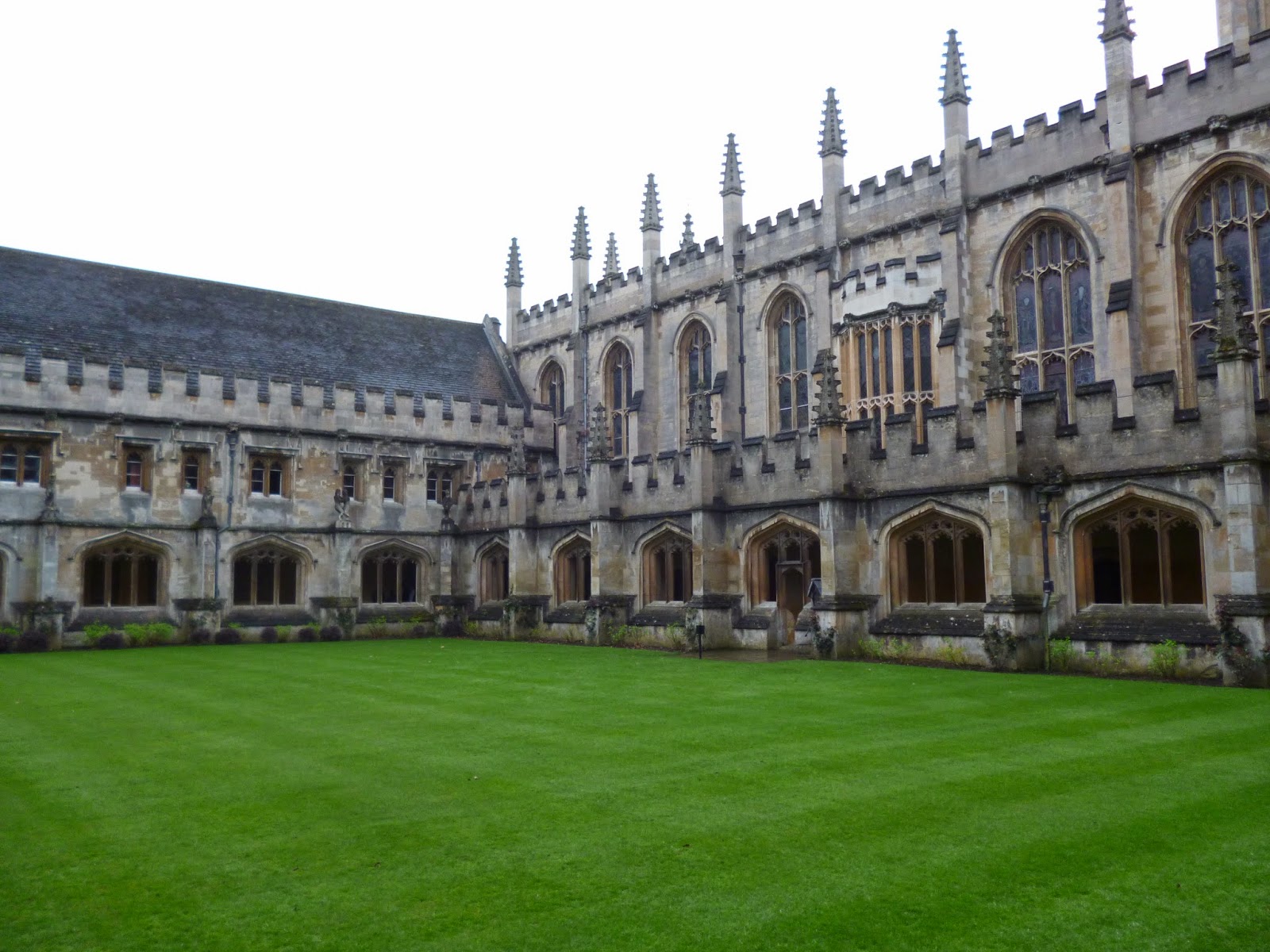
The cloisters, Hall and chapel, Magdalen College, Oxford

To Oxford, last weekend, for a Gaudy at Magdalen.  It's difficult to believe that it's fifty years since I started my degree there.  I'd only been to one Gaudy before, after which I concluded that I'd been right to keep up with the people I had and not more.  That was the best part of twenty years ago, when I was still in the City.  It seemed churlish not to go along with the suggestions of old friends and try again.

I'd been given a room that was a sort of semi-underground burrow, with the luxury of an en suite shower room but a carpet so filthy I wasn't inclined to walk on it in bare feet.  The profusion of cream paint brought back vividly the terrible drabness of so much college life.  Conversation at dinner was uphill work.  The speeches, by the President of the College and a knight of the realm respectively, were only semi-audible, and after straining to catch words of wisdom I concluded it wasn't worth the effort.  "The trouble with men is that as they get old they either die or grow pompous," said a woman I once met.  I'm not sure about the pomposity.  It may be that dull is a more appropriate word.   

An alarming reminder of what I was like as an undergraduate occurred when two men a little younger than me introduced themselves and asked me if I recalled their frequent visits to my rooms for coffee in my third year.  Scarily, I had no recollection of either of them. One said "You were so wonderfully opinionated".  So some things don't change.  

I had no thrilling encounter with anyone I hadn't seen for years and who will be my new best friend.  The most interesting part of the weekend was the light it shed on the tricks of memory.  I had forgotten the misery of much of my time there, when I felt inadequate and depressed by the medieval melancholy of the environment.  I had not realised how much of that time I had blotted out when looking back.  The whole experience was amazingly valuable, and a great privilege.  But I'm glad to have moved on.

One of the best things about the weekend was the poster at Oxford Station that I saw while waiting for my return train.  "God shows his love for us in that while we were still sinners Christ died for us" it proclaimed.  Then "To know more phone Jeff", with a telephone number and a picture of Jeff at the side.  I am keen to know more about Jeff.  Is he a person or a trade name - an acronym, even, for something like "Jesus Evangelises For Free"?  I have a phone call to Jeff on my To Do list.  Surely he tweets for Jesus?

Antony Mair

Sunday, 23 March 2014

Vocal Explosion in St. Clement's Church

pic Juliet
 Juliet Russell, of Vocal Explosion - courtesy of their website

We found ourselves last night in St. Clement's Church, in Hastings Old Town, to hear a programme of gypsy music from the community choir Vocal Explosion.  We hadn't ventured inside this fourteenth-century gem before, but had read about its refurbishment (which aroused the usual mix of "they've ruined a lovely church" and "what an improvement on what was there before").  Personally, I quite like a mix of ancient and modern, so was not offended by the renovations.  It makes a good concert venue, and the assembled ladies and gents of the community choir filed in happily to the chancel, for a programme of gypsy music from Spain to Romania.

Community choirs make no pretension to be grand opera, the purpose being to have a good time with the music as much as to produce a decent sound. The men were, as usual, vastly outnumbered by the women - to the point where, from our position half behind a pillar, the former were completely invisible.  But the women - dressed for the occasion in "sunset" colours of orange and red, some with roses in their hair - certainly seemed to be enjoying themselves, swaying and smiling in a Carmen-meets-the-WI fashion.  The choir was led by Juliet Russell, who had two roses in her hair - a little offputting since from the rear they looked like a couple of stick-up ears, and reminded me slightly of Bambi, for some reason.  Our neighbour in the audience, who told us she had sung with the choir for nine years but was taking a break from it at present, said that Juliet Russell composed some of the numbers herself.  If so, she'd done a good job.  Some of the harmonies were powerful - particularly in an opening number called Asla, which sent shivers down my spine.

The slight tendency towards a revivalist meeting became more pronounced after the break, when Juliet Russell encouraged the audience to clap rhythmically and access their inner power (I may have got that last bit wrong, but you probably get the drift).  In the last number, where the choir was swaying and the audience standing and clapping I warned Paul that I might soon be speaking in tongues.  The man in the row behind us said he wished the Sunday service was as lively.  

I have my reservations about gypsy music - it can sound a bit same-ish after a while, and I can only take so much of dancing beside bonfires.  But the rhythms were good, Juliet Russell impressed as a husky-voiced Carmen and the lady beside us was whooping with applause like any teenager.  I expect to see her with a rose in her hair next time round. 

Antony Mair