Friday, 19 October 2012

Refugee cooking

Reduced cooking facilities
 
I had been dreading the turmoil of builders coming in.  Having just got used to the vagaries of our kitchen, I was going to see it all thrown to the winds.  I began to think of how we would cope.  When I looked at the Argos catalogue, however, the possibilities seemed greater than I had anticipated.  The last time I endured this upheaval I'd got a microwave and a double ring and washed up in the bathroom basin.  This time at least I had the sink in the utility area (a rather grand name for a space under the stairs).  But Argos opened my eyes to the possibilities of steamers, slow cookers, halogen ovens and deep fryers.  Friends recommended something with an incomprehensible Czech name that could substitute for an oven. 
 
Unusually, a sense of proportion clicked in: Paul's tenants next door are moving out at the end of the month so we only had three weeks or so to endure serious chaos, as we could move in there for the worst.  I'd been thinking of a slow cooker: then one day there was a smell of something stewing next door for the whole day, and I realised that a slow cooker would fill the house with a casserole smell for hours.  Fine if you're out at work but a bit of a pain if you're in.  So that was out.  The incomprehensible Czech cooker came in at over £100 so that was eliminated as well.  I thought I could manage fine with a two-burner ring and a steamer.  After all, steamers are healthy, aren't they?
 
The steamer certainly works.  And I'm sure it's a healthy way of cooking.  However, what they don't tell you is that the steam has to go somewhere, and that it emerges from holes in the top tray and on to the ceiling.  If the ceiling's low and old, you start getting concerned about the possibility of eating lath and plaster with your veggies.  Also, when you come to dish up, and remove the tray from the steamer, water drips out over work surface and floor.  So it's not ideal.
 
The two-ring burner, on the other hand, has been rather a triumph.  I've managed to do a casserole on it without difficulty, and of course the frying-pan plus pot of boiling water combination for veg has worked a treat.  The steamer has come in as an auxiliary.  I'm feeling quite proud. 
 
On the other hand, the tenants told us today that they've exchanged contracts on their new house and are definitely moving at the end of the month.  Phew! 
 
Antony Mair  

Sunday, 14 October 2012

Hastings Bonfire Night

Part of the Bonfire Night procession
 
 
We had been told that Hastings Bonfire Night was something not to be missed, so we gave up the original plan to go to Eastbourne for the Met Opera direct transmission and stayed put.  Indications of what was afoot were already apparent the previous evening, when I was giving the dogs their late walk down All Saints Street: figures in top hats and feathers, frock coats and boots, looking like undertakers out of a Hammer Horror film, were wandering home after final preparations. 
 
The event fully lived up to expectations: just after 7 pm the beacon was lit on the top of East Hill, and a procession started, led by drummers, of Sussex bonfire societies and various community groups, in costumes varying from the Hastings stripy sweaters as above, topped with the top hats and feathers, through convict dress with arrows on (Battle Bonfire Society) to one group who looked fresh from the Venice Carnival - I'd got a bit confused by this stage about who was who.  Each group had at its head a standard-bearer, with a shield lit by three flaming torches.  There were of course additional torches, as you can see from the photo: it was a miracle that the overhanging half-timbered houses were not set alight.
 
At 9 pm a huge bonfire was lit on the beach, and then there was a fine firework display, watched by thousands of people.  I don't usually like crowds but this was a good-tempered lot enjoying themselves.  Things were a little different by the end of the evening, when the dogs were given their final walk: a number of folk in the streets were very much the worse for wear, finding their way home with some difficulty. 
 
The atmosphere was so pagan that I found it difficult to believe that it stemmed only from the celebrations in 1605 following the failure of the Gunpowder Plot.  The proximity of the autumn equinox made me think that there might be a link with pagan equinoctial rites involving fire.  There doesn't seem, however, to be any historical basis for this.  The truth is, I suspect, that Hastings folk seize any opportunity to dress up in costume and have a drink or two.
 
Antony Mair  

Saturday, 13 October 2012

The Jimmy Savile affair - part of a wider pattern...

 
Posterity will judge us by how we treat the vulnerable
 
 
The sheer scale of what is being unfolded in the press about Jimmy Savile's alleged sexual abuse of vulnerable people is both shocking and depressing.  It is scarcely possible to believe that those responsible at Broadmoor, Stoke Mandeville and the BBC were entirely unaware of what was happening.
 
What makes the whole saga doubly depressing, however, is that this comes after a sequence of events over the past few years that have damaged beyond repair our trust in the pillars of society.  Arguably it all started with the disclosures about paedophilia - first in the Catholic church and then in children's homes.  The most depressing aspect of this, for cradle Catholics such as myself, was the way in which the Catholic hierarchy had covered up what they knew.  It destroyed my confidence in the socalled princes of the church.
 
Then there was the phone-hacking scandal.  We all knew that the tabloid press were devoid of morals, but the subsequent Leveson enquiry uncovered rather too cosy a relationship between the press, MPs and the police.  Just as our confidence in the police was being eroded, the Hillsborough scandal broke, revealing the full extent of the police cover-up.
 
We live now in a largely post-Christian society.  The Christian framework of values, which has been the backbone of our society for centuries, has been swept away.  However, without a backbone the body collapses.  Tinkering with well-meaning reforms and human rights does not appear to be a solution.  These are constraints externally imposed, rather than beliefs intimately held.  In this changing scheme of things it is the vulnerable in our society - the poor, the old, the disabled - who are most at risk.  When their guardians - the clergy, the police and government - are shown to be lacking in the essential qualities they need, the future is bleak.
 
Antony Mair

Friday, 12 October 2012

Back to chaos...


No, not Afghanistan - the Shoebox kitchen
 
Eleven years or so ago I extended the back of my London house and renewed the kitchen.  It involved a miserable life for a number of weeks, cooking on a camping stove and washing-up in a bathroom basin.  Then we moved to France, and the building works were so radical that we moved out for eight months.  Now - plus ça change etc. - we find ourselves back in chaos again, with the replacement of the kitchen in the Hastings Shoebox.
 
When I bought the house I knew that the kitchen was the weak point.  We'd originally wanted to knock through the chimney breast into the dining-room at the front of the lower ground floor, making an open living and dining area: but there was no hope of getting that past the listed building authorities and in any event it would have meant removing the whole chimney breast, which, we soon realised, probably kept the house up. 
 
We hadn't reckoned with the kitchen layout being illegal, however.  A small range cooker had been placed in the chimney breast, too close to the walls and in particular too close to two electric power points.  So, never ones to do things by halves, we had to go the whole hog and rip it all out.  Again, however, we had not reckoned with the need to dry-line the walls with lath and plaster - yes, gentle reader, these ancient buildings have to be treated with respect - involving a period of five or six weeks for the three coats of lime plaster to dry out, one after the other. 
 
As if this weren't enough, most of the other rooms in the house also need some dry-lining work.  Aargh!
 
The silver lining in this cloud was the news from Paul's tenants in the Matchbox next door that they would be moving out at the end of October.  So we shall be able to transfer through there for a couple of months.  The fly in that ointment is that some work is needed on the Matchbox windows, so we may be peering through scaffolding in our more comfortable quarters.  Roll on 2013...
 
Antony Mair
 
 
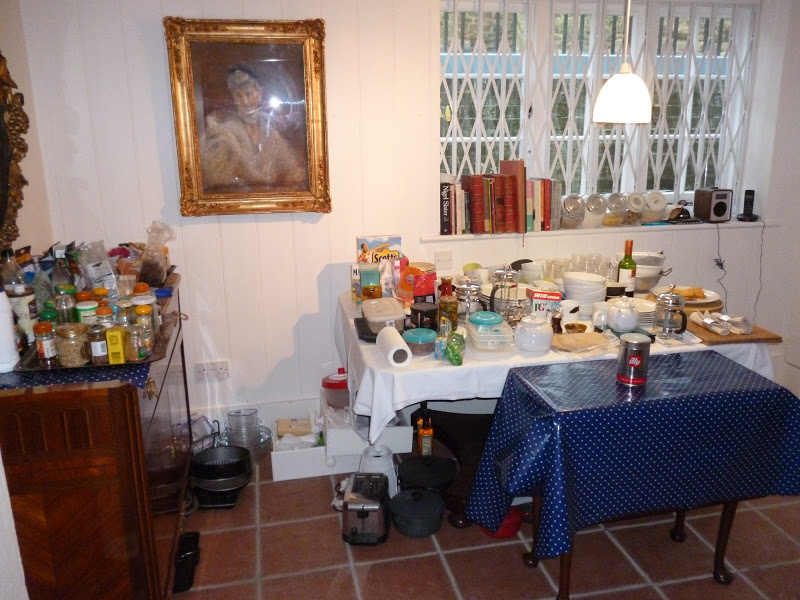
Living like squatters in the dining-room


Monday, 8 October 2012

Always a weekend event in Hastings!


From the sublime...
 
You may well - and rightly - have the impression that there is a succession of small events and celebrations in this seaside town.  On Saturday we had the beginning of what is called "Hastings Week" - a series of events that culminates in the UK's biggest bonfire, a little ahead of November 5.  On Saturday and Sunday there was a classic car rally on the Stade: Saturday was a fairly small business when I strolled down in the afternoon, though this Chevrolet struck me as being particularly magnificent. 
 
Sunday was another matter: the space was packed with English and American cars, polished and lovingly tended by fanatical owners.  The older generation were out in full force, reminiscing about the cars of their youth - and I have to confess that I engaged in a fair amount of this myself.  Looking after and restoring old cars may have its nerdy side, but - as I recall a young criminal saying once in another context - "it's better 'n' beatin' up old grannies, ennit?"
 
Antony Mair
8 October 2011
 
 
...to the (faintly) ridiculous!


Friday, 5 October 2012

The English press and the euro crisis


The appropriate attitude to the global economic crisis?
 

Since the economic storm hit us all, I have been intrigued by the differing attitudes of the English - or I should say Anglo-Saxon - press and their French colleagues.  As far as the latter are concerned, France is basically ok and a collapse of the euro is more or less unthinkable - or, if thinkable, not desirable.  Whereas the Anglo-Saxons regard the collapse as inevitable, displaying a rather unattractive Schadenfreude whenever there is an adverse turn of events that makes things more difficult on the Continent.  Similarly, the Anglo-Saxons regard the French economy as floating on air, while the UK is basically solid.  On this point, however, the French usually confine themselves to commenting that the UK is in no better a situation than France.

This last is the one point that appears accurate.  The two countries have a similar debt/GDP ratio.  In principle France could resolve its problems by slashing the public sector, which sounds easy for a country with one of the highest levels of government costs in the EU.  In practice this is far from easy, and could cause massive social unrest.  The UK has a leaner public sector, so there is no easy solution, and tax revenues are less than anticipated.  The austerity vs. growth conundrum is similar in both countries.  And while France is exposed financially in providing support to the southern European states and Ireland through the central EU mechanisms, it also has the richer EU partners to lean against. 

My own concern is that, in each of Greece, Spain, Portugal, Italy and France there are profound cultural changes that have to occur before I can see any material improvement.  And I don't see how that is going to happen.  For example, in Greece the professional classes - which count the majority of MPs among their number - habitually avoid (possibly evade) their taxes.  Nothing much is to be gained by cutting salaries and pensions of civil servants while this sector of the population effectively escapes having to join in the pain.  In Spain, Italy and Portugal cronyism is the name of the game, blunting competition.  In France the burden of bureaucracy on business has to be eased in order to free up the entrepreneurial energy that is being stifled in the private sector.

I have to say that I don't see how any of these issues are going to be satisfactorily tackled.  In the circumstances, I think that our dog Oscar, pictured above, has found the appropriate solution: find a patch of sun, stretch out and go to sleep!

Antony Mair   

Monday, 1 October 2012

Slavery - still relevant?

 
Houses designed by Decimus Burton, Saint Leonards-on-Sea
 
 
There seems to have been a recurring theme of slavery in my reading matter recently.  It started with my reading André Brink's fine novel Phylida, based on an episode in his family's past.  It is set in South Africa in the 1830s, when slavery was about to be abolished.  André Brink is an author I admire in any event, and this novel was longlisted for the Man Booker prize, so I read it as part of an exercise in ploughing through the longlisted novels as a whole.  It is a fine book: Phylida is a slave who dares to say no.  The final part of the novel has some of the grandeur of myth.
 
Phylida's ability to resist oppression was based in part on the legal framework being put in place for the emancipation of slaves.  I am not sure that the same advantage was available to the twenty-five slaves who were the subject of a legal transfer I came across a week or so ago, dating back to 1791, and executed by one of my mother's forebears as part of a marriage settlement in the West Indian island of Guyana.  I had no idea that my great-great-grandfather had employed slaves - but had I given some thought to the fact that he had plantations in the West Indies I suppose it would have been obvious.  It made me wonder how much prosperity in nineteenth century England derived from this source.
 
We would all like to think that slavery is something not only barbaric but remote from our existence.  However, a newspaper article yesterday highlighted new forms of slavery that are causing concern in the present day, on our doorstep: forced labour of immigrants and people with learning difficulties.
 
Thinking about it, I came to the conclusion that the attitude of mind that enables people to exploit their fellow human beings as slaves is only an extreme form of the attitude of superiority adopted by many human beings towards their fellows.  This reminded me, on a lighter note, of a story I heard recently of an incident some forty years ago, involving a wealthy couple who were having some major building work undertaken on their house.  Tea was sent out to the builders in jam jars, on a tray.  Outraged, one of the builders took the tray back and said to the mistress of the house "You folk may drink your tea from jam jars but where we come from we use cups so we'll go off and have our tea down the caff".  Collapse of stout party...as in the case of André Brink's Phylida, it takes courage to say no. 
 
Antony Mair