Friday, 9 November 2012

The Quiet Revolution

Holy Trinity Church, Hastings
 
Change in society is always interesting.  And we live in interesting times.  In recent years we have seen uprisings in Middle East states, where people have dared to protest against - and in some cases overthrow - powers in government.  Much emphasis has been placed on social media as an important element in this: but my own suspicion is that social media have been no more than a tool, rather than a prime mover.
 
My view that something was afoot on a more global basis has been reinforced by the re-election of Barack Obama.  It now looks as if the Republicans severely miscalculated in failing to acknowledge the power of racial and social minorities, who voted with their feet.  We are probably witnessing the end of white Anglo-Saxon dominance in American politics.
 
Something similar has been happening in the UK, with the unravelling of sex scandals involving first Jimmy Savile and then a Welsh children's home.  After decades of silence, the victims have dared to speak out.  And whether the Tory right wing likes it or not, any suggestion of a cover-up in both cases appears to be linked inevitably to an Establishment perceived to be exploitative and out of touch.
 
What we are witnessing is a rapid erosion of trust in institutions that have let people down: and the acquisition of courage and a voice by the victims.  Time was when those in power could abuse their position.  That is less and less the case, either in the Middle East or closer to home.
 
The Christian churches have largely been sidelined in this process: the Catholic church has been discredited by a series of paedophile scandals, and the Anglican church is perceived, rightly or wrongly, as part of the Establishment that is failing to carry out its responsibility.  
 
This failure is, in the end, what it is all about.  Poorer sections of the community will tolerate disparities of wealth if they believe that the rich and powerful generally exercise their power for the greater good.  That is the responsibility that comes with privilege.  But history across the Channel shows graphically that where the responsibility is not observed, retribution is inevitable.  
 
Antony Mair
    

Monday, 5 November 2012

Move to the Matchbox


Our travelling life continues: from the refugee encampment in the basement front room of the Shoebox we have moved next door to the Matchbox.  To refresh your memories: in the picture above, taken from East Hill, you can see the Shoebox, which is the darker blue of the pair of houses on the corner of Crown Lane.  Beside it, a paler blue/grey, is the Matchbox.  Paul's tenants obligingly moved out last week so we have been able to move across in order to free the Shoebox up for builders who have to go in and dry-line the sea-facing interior walls with lath and plaster - I'll spare you the technical reasons.  Suffice it to say it's one of those irritating things that has to be done at vast expense but which nobody notices afterwards. 
 
We hired a couple of men from a local removals company to give us a hand and it was all comparatively painless.  It's a little strange to have moved house again after five months, and it will be even stranger in around three months' time when we move back.  By that stage, hopefully, we shall be able to look forward to a degree of stability.  I keep on remembering all those statements about moving house being the third most stressful experience in one's life: but in fact I'm so delighted to be back in a working kitchen that the stress has been reduced.  An added bonus is that the two properties are so close that we don't need to have a new telephone number: we just brought the extension phones over!  and our computers can link up via wi-fi with the router next door, so the disruption is pretty minimal. 
 
Disruption will however continue: scaffolding on the street side is due to go up at the end of the week for repainting both façades so that they match.  I am hoping that it will all be worth it in the end, even if we are on bread and water for months!
 
Antony Mair

Friday, 2 November 2012

Revisiting the Pre-Raphaelites

 
Rossetti: The Beloved
(reproduced courtesy of Tate Britain)
 
 
I went up to London yesterday to see the Pre-Raphaelite exhibition at Tate Britain.  I've never really cared for the PRB (this trendy acronym was adopted by the exhibition organisers, and denotes the Pre-Raphaelite Brotherhood - feminists can refrain from comment).  But I wanted to see the exhibition to see whether I might have changed my view, with the passing of time.  But alas, no. 
 
I did come away with two things, however: the first was that I had always thought of the PRB as being later in the nineteenth century than they were: in fact they kicked off in the middle, rather than towards the end, and were therefore ahead of the Impressionists.  So the idea of them as a rather pathetic alternative to their more successful French contemporaries isn't correct, since they weren't really contemporary at all.  Secondly, though, on reflection it had not occurred to me that their preoccupations were more social than the Impressionists' concern with paint and how things are seen. 
 
It may be for this reason that, in the final analysis, they continue to leave me cold.  The anachronistic nature of many of the paintings is incongruous: the costumes are medieval, the facial expressions and poses distinctly Victorian.  More disconcertingly, a number of the persons portrayed are just begging to have bubble comments put beside them: take the lady on the right in the picture above.  She's obviously asking the girl behind whether she's remembered to bring the tickets.  The one on the left appears to be saying to the central figure: "Keep looking him in the eye and he'll give way".  While the central figure herself seems to be saying to the onlooker:  "Ok, this is who I am."  This all builds up to the idea of girls confronting a bouncer outside a nightclub. 
 
I don't want to press the point too much.  Some of the smaller paintings are beautiful.  I also particularly liked the stunning William Morris rug, portrayed below (again courtesy of the Tate), which I could happily have packed up in my bag and brought home had we a room large enough for it.  The colours still gleam like jewels.  But the great set-pieces of the PRB continue, I'm afraid, to leave me unmoved.
 
 
Antony Mair


Monday, 29 October 2012

Camber sands

Camber sands
 
 
The beach at Hastings is shingle - as are the beaches all the way to Brighton going west.  On the other side of Rye, however, to the east, Camber has wide expanses of sand.  In the summer months there is a permanent traffic jam of holidaymakers and their cars and caravans.  But outside the holiday season the sands provide a wonderful expanse for walkers and their dogs.
 
Camber itself is a nondescript village, with some cafés and small restaurants catering to the beach crowd.  But a dog-walk on the sands followed by scampi and chips is a good way to pass a sunny day.
 
There are those among you who have asked for more pictures of the dogs: I spent a fair amount of yesterday trying to get an adequate photo, but they were moving too fast for me, and I have a collection of pictures full of blurred fur scuttling out of the picture.  The only time they seemed to come to rest was when there was the prospect of a treat.  So here you are.


Saturday, 27 October 2012

Shanty Night at the Stag Inn

Shanty Singers at the Stag
 
The Stag Inn is at the end of All Saints Street furthest from the sea.  I pass it almost every night as I give the dogs their final walk of the day.  On various nights in the week there is the sound of singing as I walk by, and on further enquiry I found that on Tuesday nights there are folk songs, on Wednesdays "Blue Grass" music, and on Thursday night the Shanty singers.  I've been wanting to go along to hear the shanties for a while now, and finally we got there last Thursday, with our neighbours Ian and Ketil.
 
They serve more than passable food at the Stag, and we had a good dinner in what seemed an almost deserted bar at the front of the pub.  Come nine o'clock, however, various people started drifting towards the back: they were out of sight but it soon became clear that that was where the action was.  In a separate bar at the rear the singers sat or stood round a central table, while others occupied space round the edge.  There didn't seem to be any spare seats, but everyone was very welcoming and more chairs and stools were produced for us.
 
The singers in the group took turns: the pattern of a shanty is that there is a sequence of verses with a chorus.  The chorus may be to accompany the heaving of sails or winches, or just a way of getting people to join in, and varies in length.  But everyone joins in, and since both words and tune are easy to remember it's easy to feel part of the group.  The photo - taken by Ketil on his phone, so not of the first quality - gives an idea of the event.
 
It was brilliant.  We shall be heaving and ho-ing again, I predict.  Avast and belay etc. 
 
Now I've got to go and get that parrot.
 
Antony Mair


Wednesday, 24 October 2012

Back to poetry...


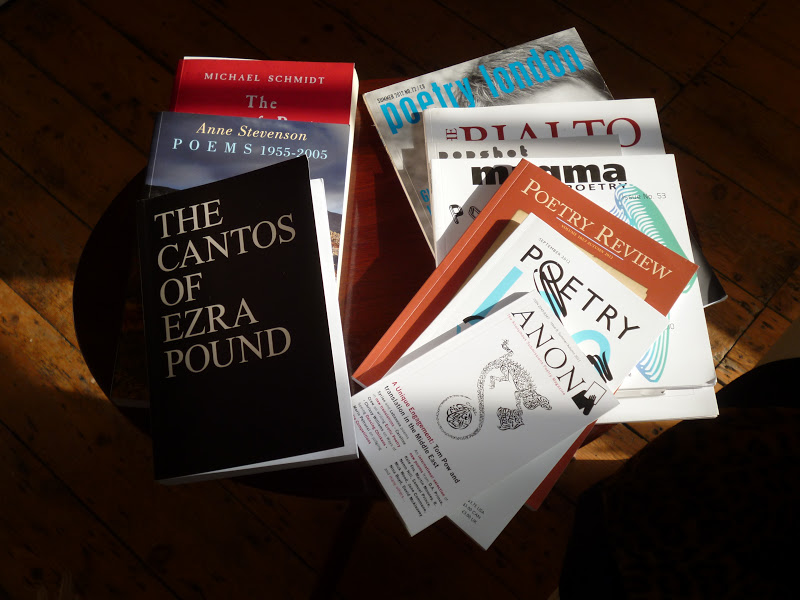
Before we moved back to the UK, friends would ask us what our plans were on our return.  Paul's were straightforward: to get back into agency.  Mine were rather more vague: I wanted to spend time reading up on a variety of topics - the history of religion; psychology and the development of consciousness in evolution; cognitive neuroscience - in order to try and make some sense of the world we're living in.  In fact, as matters have worked out I find myself more or less back where I was when we left the UK in 2005: writing poetry.
 
Poetry is big in the UK.  "Poetry News", which comes out four times a year, receives 3000 submissions a year, of which it publishes 150.  The annual National Poetry Competition, run by the Poetry Society, received 8000 entries last year.  The Poetry Society runs the Poetry Café in London; the Poetry Library on the South Bank is well-frequented; and throughout the country there are groups and individuals poring over verse.
 
Some months ago I joined two groups: one in Hastings and another in Brighton.  Both meet monthly.  The Hastings group brings together people who read what they have written on a theme given out the month before.  The Brighton group - one of the Stanza groups run as local presences of the Poetry Society - operates as a workshop: each person brings along something they have written and the others present give their comments.  You need to be able to make constructive comments and take criticism yourself.  I find it incredibly useful. 
 
It's curious to find that I took up, almost seamlessly, from where I left off in the spring of 2005.  I'd done little writing in France: the demands of the agency absorbed most of my energy.  Now I'm back, everything seems to have fallen quietly into place.  The other day I discovered that my study window looks onto the house of a neighbour who runs a small poetry press.  It all seems part of the curious serendipity of this surprising town.
 
Antony Mair

Monday, 22 October 2012

Season of mellow mists...and tax returns

View of the Stade from the end of Tackleway
 
Keats got it pretty badly wrong these past few days.  It's been wet, wet, wet: more like Lincolnshire in Bleak House: "The weather is so very bad, down in Lincolnshire, that the liveliest imagination can scarcely apprehend its ever being fine again".  Today the rain has disappeared, but a sea mist has blotted out not only the beach but the other side of the Old Town.  No sign of Keats' "maturing sun".
 
So we've been deep in paperwork: UK tax returns are meant to be in by the end of the month, and I felt smug at getting mine in ahead of the deadline.  Paul detests formalities of this kind, so there is always a bit of a last-minute drama: but even he has been sorting out papers and contacting his accountant.  At the same time, post comes in from the French tax authorities: the elaborate calculations set out on the back of the large form are unfortunately wrong, and I have to write to claim a refund they've conveniently ignored.  Just as I think things are clear, in comes another demand - for social charges.  Yuk.
 
As if all the tax stuff isn't enough, we're winding up our little French company.  Our French accountants have emailed me a mass of documents.  It takes me the best part of a day to sift them through, print them off, sign the relevant number of copies and arrange return packages to Ribérac - one for the accountants, the other for the tax office.  This is a load off my mind since it spells the imminent end of my need to continue paying French social charges.  The only silver lining to this particular cloud is that, if I can thread my way through another bureaucratic labyrinth, I am entitled to a small French pension as a result of my contributions.
 
I shall be more than relieved to tie up all the French loose ends: I never felt I was entirely in control of the bureaucratic process.  On discussing it with French friends I found that they experienced much the same.  Social charges, in particular, remained a mystery to me even after seven years.  I understood the basic process but it struck me as cockeyed, and the results apparently arbitrary.  What is particularly irritating is the sense that the bureaucrats start with the view that you're a villain, wanting to evade all payment.  The result, of course, is that you reach a point where you want to act the rôle they've cast you in.
 
It occurs to me that the first chapters of Bleak House are all about fog, used as a metaphor for the legal obscurities of the Chancery courts.  It seems appropriate that I should be dealing with all this stuff as the mist rolls in...
 
Antony Mair