Sunday, 16 June 2013

New challenges in gardening

Not exactly spreading acres...

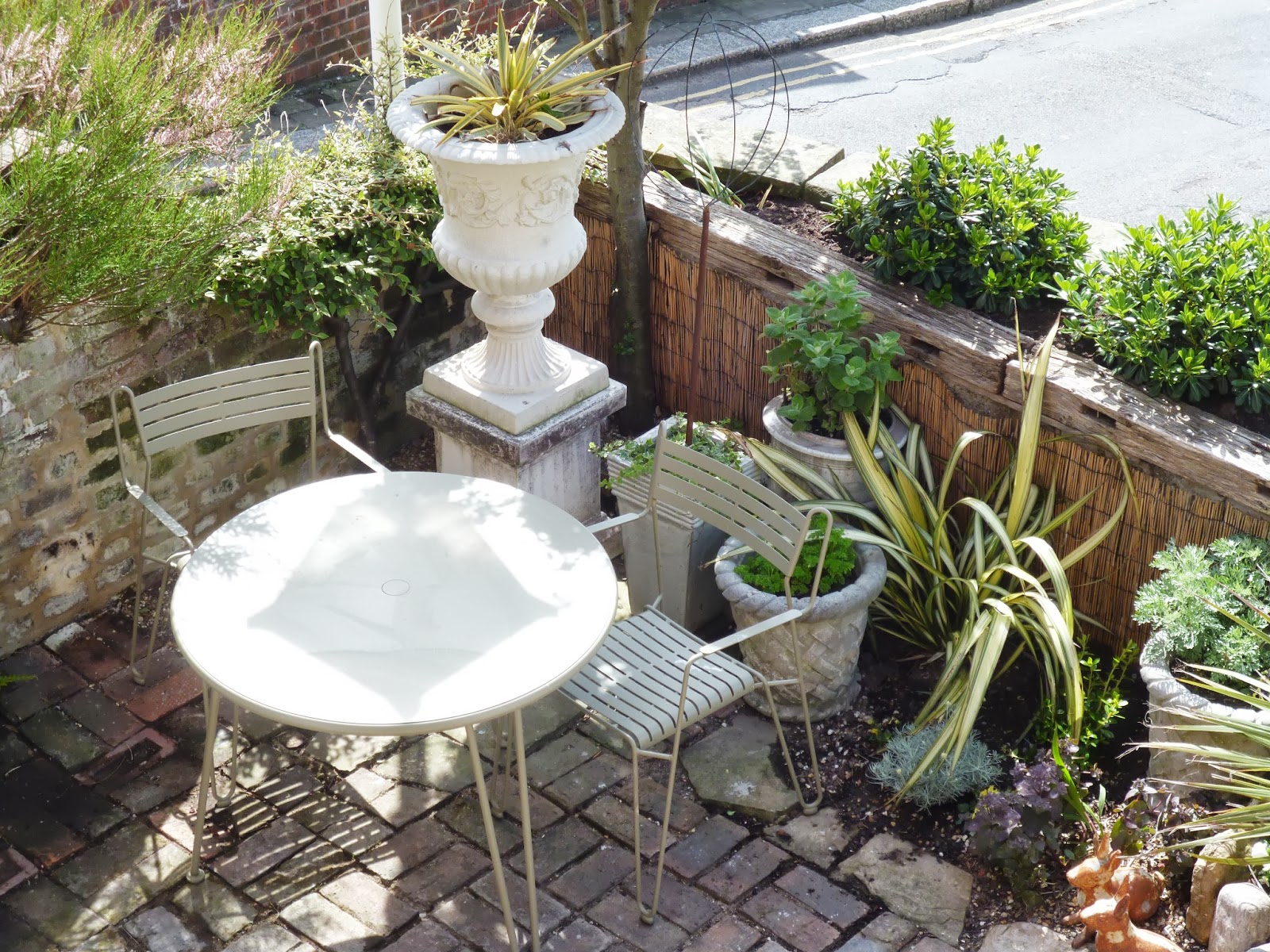
When we acquired the Shoebox the two obvious disadvantages for one who loved cooking and gardening were the minute kitchen and the diminutive back yard garden.  The kitchen problem has been resolved by replanning, and I now revel in it.  The garden has proved a little more problematic.  

We're talking of a space about four or five metres long and about three or four metres wide - a little wider if you take in the space at the bottom of the flight of steps that come down from the rear door on the ground floor.  We have a couple of flower beds, but the major part of the area is paved in brick.  It faces west, and gets a lot of light.  The views between neighbouring houses to the sea, to the south, and the open view of the Old Town to the west, are stunning.

All of this is fine.  The real problem, though, which I hadn't bargained for, is the wind.  It howls off the sea, bringing an abundance of salt.  All those delightful plants you see in cosy Sussex gardens simply shrivel and die with us.  Add to this a rigourous winter such as we have just had, and it's a miracle that anything at all has survived.  Last year we planted phormiums, which have staggered through but are looking a bit sorry for themselves; lavender, which has somehow been able to cope; and sedum and artemisia.  The sedums would have coped had it not been for another hazard - snails.  They've more or less survived but aren't exactly flourishing.  

This year we've taken a more restricted approach, and filled a number of gaps - it's quite surprising how many gaps there can be even in a space as small as this.  I'm not sure we'll ever create something with that Amazon jungle look, but we're gradually learning.  

Antony Mair


Saturday, 15 June 2013

Frozen out at Fairlight Hall

Fairlight Hall

The thing about summer in the UK is that we've all got this idealised picture of balmy afternoons and evenings, strawberries and cream, cricket matches in the heat etc. - whereas the truth is very different.  People moan about climate change but I have distinct recollections of watching opera in country house venues years ago with the rain lashing down on the marquee - even one occasion at Glyndebourne when everyone was picnicking on the covered walkways like stranded refugees in dinner jackets.  

You'd think, therefore, that when we booked for a concert at Fairlight Hall, just outside Hastings, we would have been sensible enough to equip ourselves with several layers of clothing, not to mention shawls and overcoats.  However, we'd been working in sunshine in the back garden and toddled along to Fairlight in our innocence, lightly clad, to hear a recital by the wonderful Tae-Hyung Kim.  

Fairlight Hall is a Victorian pile owned by David and Sarah Kowitz, who are generous patrons of the arts.  They have converted a stable block into a concert room, the entire side of which opens out, by means of a sequence of folding doors, onto a courtyard.  Four giant umbrellas protect those sitting in the courtyard from the rain, but not, alas, from the wind and cold.  We realised our mistake at the outset, when we saw others dressed as if for the lower slopes of Everest, but hoped that we could cope.  

Tae-Hyung Kim is a superb pianist, who won the Hastings International Piano Concerto Competition a few months ago.  In the first part of the concert he played two arabesques by Debussy, a piece by Satie, three brief sonatas by Scarlatti and extracts from Prokofiev's Romeo and Juliet.  His playing is wonderfully expressive and he discharges the bravura pieces from Scarlatti with extraordinary lightness of touch.  The Debussy was a marvel of tenderness and sensitivity.

But alas, while he played the wind howled in the trees of the neighbouring park and whistled round our courtyard.  In the interval we decided that we had to incur the penalty of our foolishness and miss the second half, rather than risk colds.  Next time we shall try to remember the truth about English summers rather than the idealised memory! 

Antony Mair


Monday, 10 June 2013

Paul becomes a Winkler

Winkle Island, with Winkle sculpture by local resident Leigh Dyer

On the other side of the street from the new Jerwood Gallery there is a paved area known as "Winkle Island", with a somewhat baroque sculpture in what appears to be stainless steel, of a giant winkle with a base of mackerel and rock.  The metal winkle serves as a collecting box for donations to the Winkle Club, formed in 1900 by the Hastings fishermen as a charitable vehicle for donations to the poor.

Membership of the Winkle Club is by invitation, and Paul was flattered recently to be asked to join, by our neighbour, the composer Polo Piatti.   He was admitted to membership at a ceremony in the Fishermen's Club, in the course of a social evening attended by other Winklers (as members are known) and presented with the small winkle shell that he now has to keep with him at all times - failure making him liable to a fine if he is unable to produce the shell on being challenged by another member with the formula "Winkle up".  

Good-humoured bonhomie was the characteristic of the evening, with music from the Goodall Brothers (a duo not in the first flush of youth but no less accomplished performers for that) singing a selection of golden oldies from the fifties and sixties.  As in all local events, you recognise faces, and it's like pieces of a jigsaw slotting into place - Keith Goodall works in our fishmonger's, and another Winkler present was Arthur Read, whom I pass regularly at his fish-stall behind the Jerwood.  

Famous Winklers include Winston Churchill in the past and the Duke of Kent and the Queen in the present.  Paul is now added to their number, and has the task of raising funds for the Club coffers.  Hastings people being fond of dressing up in costume, this may involve him donning some strange outfits.  Pictures will follow!

Antony Mair

Friday, 7 June 2013

Visiting Mykonos


Mykonos - the town

After a winter that seemed to last forever, we needed a break.  With the weather continuing to be unpredictable, the Greek islands seemed a good option, so we booked a week in Mykonos.  The last time we were in Greece was in a French holiday camp in Crete, so things could only look up.  A well-heeled friend of Paul's recommended a swanky hotel, so we threw caution to the winds and booked.

The pool at the Myconian Ambassador
The hotel turned out to be paradise itself.  If you want an idyllic place to stay, with a stunning view of the sea, untroubled by the party party mentality that afflicts large sections of the public as soon as they get off a plane, then book yourself into the Myconian Ambassador hotel.  The food surpassed anything I've experienced in Greece, although we rationed ourselves a little in order to preserve the wallet.  The staff were charming, the environment impeccable.  The other guests came from all over the world, including the States and Japan.
Back street in Mykonos town
Little on the surface of this elegant island indicates that Greece is in economic difficulties.  The main town is a labyrinth of narrow streets, giving the effect of a Middle Eastern souk.  Its shops include some very fancy jewellers.  We were told that these cater for a cruise-ship clientèle.  Who are these people, who leave their ship for a few hours to visit a small island and spend upwards of ten thousand pounds on some diamonds?  Chanel and Louis Vuitton were also present.  More Saint-Tropez than Captain Corelli.
Apart from our hotel, the culinary experience left a certain amount to be desired.  Greek cuisine has advanced since my visits back in the 70s, when the ubiquitous Greek salad made its appearance twice daily on the table, but locals still hanker after the traditional experience of the simple restaurant on the beach.  We sampled one such, where Paul's main course was a large wad of moussaka and I was confronted by half a leg of lamb.  The pallidly greasy chips that came with both were a long way from the current insistence on double and triple frying.

In July and August I imagine that the combination of heat and crowds make the Mykonos experience pretty hellish.  But at the beginning of June it was a perfect break, and we felt a bit of a pang on leaving.  The only remedy is to book another break!

Antony Mair


Friday, 31 May 2013

Adding to the cyber-noise

View of Hastings Old Town from East Hill

When I started this blog a year ago I circulated friends and contacts to tell them about it.  In the email I said I was going the blog route because Facebook was a step too far.  Subsequently, however, I put the odd entry on Facebook to promote the blog.  I even managed a tweet or two.

As time has gone by I've become increasingly disenchanted with both Facebook and Twitter.  I've followed a number of people on Twitter - poets mainly - and found that their tweets are a rather pathetic form of self-aggrandisement.  Similarly, Facebook encourages an alarming amount of posing.

But Facebook and Twitter are obviously meeting a demand.  Interest is created and satisfied.  At the same time, I've been reading in the press about how young people can feel under increasing pressure as their screen identities and lives fail to match reality.  How daft is that?  It's as if they're being sucked into a parallel and disassociated world that isn't satisfying their real needs and aspirations.  Scarily, research now shows that spending an excessive amount of time at a computer screen extinguishes those parts of the brain that use and develop social skills.  In other words, if you're lacking social skills get off the computer and into real life.

In parallel with the development of social media, the cyberworld is becoming more and more invasive.  Scarcely a day goes by without my unsubscribing from some trade circular or other.  You can't buy anything online without being added to a mailing list.  The most extreme manifestation was when a burglar alarm company I contacted sent me a follow-up email asking for feedback on the call I'd had with them, which was just to arrange an appointment for their surveyor.  The delete button came into action again.  

This blog was started to keep in touch with friends in other places - both in the UK and elsewhere.  Strangely, it's been developing a life of its own, and having started off with a few hundred page-views a month I've now just passed the milestone of a thousand.  Nothing in comparison with the number of Sally Bercow's followers on Twitter, but still a source of wonder to me.  At the same time, I'm a tad concerned at the fact that I'm adding to the very hubbub that I myself find irritating.  My only consolation is that if the blog fails to interest people they're not obliged to look at it!

Antony Mair


Tuesday, 28 May 2013

Downsizing - a sobering experience

Not exactly Christie's - Gorringes' auction rooms in Lewes

If there's one thing I've learnt in the course of the lengthy downsizing process that has taken most of the past eighteen months, it is: buy at auction rather than from dealers.  A lesson learnt rather late in the day, but brought home by the sad experience of disposing of surplus items as a result of moving to the Shoebox.

We sold some furniture and paintings with the house in Ribérac.  Before doing so, we had obtained estimates from auctioneers in Bergerac.  The sums estimated were fairly risible, but the amount we needed to get rid of was substantial enough to consign some items to them, most of which sold.  We brought the more valuable items back to the UK, and sent some paintings to Christie's in South Kensington.  In the best case the sale price was more or less what I'd paid about twenty years ago.  In the worst case it turned out that a pair of paintings I'd treasured as a decent investment, and which had been valued by Christie's on a previous occasion, were not by the artist I'd thought, so were worth about a tenth of what I'd anticipated.  I brought them back to the Shoebox.

Buying from a dealer and then selling at auction is likely to be a loss-making process in any event, since a dealer may well have bought at auction and then added his mark-up and cost of restoration.  You hope that prices in the meanwhile will have risen sufficiently to cover the difference.  Alas, this is to reckon without changes in fashion.  The fall in value of "brown furniture" - those cherished mahogany pieces from the eighteenth and nineteenth centuries - is little short of scandalous.  Great if you're buying - you can pick up a fine chest of drawers, two hundred years old, for the cost of a flatpack from Ikea.  But not much good if you're selling.  You're likely to have a similar experience with early nineteenth-century porcelain,which is now seriously out of fashion.  

My experience of sales at Christie's in South Kensington, Lots Road auctions in Chelsea, Burstow and Hewett in Battle and Gorringes in Lewes has been a dispiriting exercise.  On the other hand, we simply don't have the room any longer for the bits and pieces concerned, and I've just had to conclude that the return on the original investment has to be  measured in the enjoyment I've had from them, rather than in the (catastrophic) financial context.

In the greater scheme of things, of course, none of this is important: objects are just that.  But it's a little heartrending, nonetheless, to see one's small treasures disappear for a trifle.  My only consolation is that we need four dining-room chairs for the Shoebox, and I'm hoping to pay not very much for some sturdy eighteenth or nineteenth century items that are currently out of fashion but still appreciated by old fogies such as yours truly.  

Antony Mair


Sunday, 26 May 2013

One year back in the UK


We left France a year ago yesterday, arriving off the Channel tunnel train with the dogs and trundling along the coast road to our new quarters in Hastings.  Much has happened since that time, with extensive building works, getting used to a country that we had half-forgotten, coping with new doctors, vets, tradesmen etc. 

A return to the UK was necessary for Paul, who felt isolated in a country where he couldn't master the language to his satisfaction.  Had we stayed, the effects of exile would have worked their way through into depression.  Nor was I an unwilling passenger: having left the legal profession to spend time writing, our time in France had diverted me into estate agency, which was not what had been intended, so the chance to get back on track in the UK was welcome.

And those primary objectives have been achieved.  Paul is back in a country where, although different from his native Ireland, he can blend into local life.  I've been able to get back to writing, and am due to start my MA in Creative Writing in October. 

But at the same time, there is quite a lot in this country that I heartily detest, and quite a lot in France that I miss.  I find the insularity of the British more irritating than the nationalism of the French.  The climate is pretty awful, and unlikely to get better.  British politics seem largely governed by ad hoc policies rather than an overall view of rights and duties, and the French concept of "solidarité", however defective in practice, is vastly preferable to the hideous divisions of the British social structure.  Intellectual life in the UK seems to have retired into obscure places, leaving us with television of the Berlusconi bread-and-circuses type, Radio 4 a tedious series of pontificating drones, and Radio 3 dumbed down.  The National Health service appears to be falling apart, and the poor increasing in number.

Had we remained in France there would have been other things to lament: the sad decline of rural life; the corruption of local authorities; the inexorable rise in taxation - all of which goes to show that everything's a compromise in the end.  What has tipped the balance for me is the ability to meet other writers again and get back into the literary world in some form.  But I'd sometimes kill for a decent local market, and a blaze of sunshine. 

Antony Mair