Friday, 16 August 2013

The pleasures of portraits

"Inner Dialogue" by Jamie Routley
(by kind permission of the artist)

I had to go to London the other day, and had arranged to meet a friend for lunch at the National Portrait Gallery restaurant - handy for Charing Cross, where the train arrives.  Arriving a little ahead of time, I visited  the BP Portrait Award exhibition, which was a total delight.  

Portraits don't really lend themselves to some of the excesses of contemporary art.  Picasso probably bent the genre as much as he could, with dislocated body parts, but you could still see, more or less, that it was a picture of a human figure.  The BP portraits are largely figurative, though there's the odd gimmick - Agnes Toth's painting of Drummond Money-Coutts, the Magician, for example, is a triple portrait, three-quarter face, full face and profile, while Daniel Coves has his sitter with her back to the artist in Net No. 10.  I found  some of the "straight" portraits very powerful - the prizewinning Das Berliner Zimmer, for example, by Owen Normand, or Mark Fairnington's hyperrealistic The Rose and the Bee.

The pleasure of portraits lies in the painter's ability to get under the sitter's skin.  At their best (Goya's portraits of the Spanish royal family, for example) they have a way of revealing more about the sitter than is entirely comfortable.  It's that combination of detachment and intimacy that makes portraits irresistible, whatever the technique.

Self-portaits - of which there are a number in the exhibition - take the process in a different direction.  None of us really knows who we are.  Our identity is a muddle of preconceptions and suppressions. The artist's painting of himself, consequently, engenders questioning and uncertainty.  The intimacy of an ordinary portrait is compounded by the onlooker's intrusion on a dialogue between the artist and his image of himself.  For this reason I particularly liked Jamie Routley's Inner Dialogue, where the artist appears to be looking back at the spectator but is in fact looking into a mirror opposite another mirror, so that there is an infinite series of reflections.  The personal props - books, ornaments, the butterfly as an image of an instant of time captured,  and the hourglass as an image of time passing - contribute further to the feelings of intimacy and intrusion.     

Hurry along and see it.  Oh, and lunch on the 3rd floor was good too.

Antony Mair   
National Portrait Gallery - north front

Monday, 12 August 2013

Don Pasquale at Glyndebourne

 Picnicking on the lawn at Glyndebourne

After the seaside jollifications of Hastings Old Town Carnival, we found ourselves at Glyndebourne on Sunday for a performance of Don Pasquale, with the skittish Danielle de Niese in the star - indeed the only - female role.  After a slight scare about the possibility of rain - which sends assembled picnickers under cover where they camp like refugees in dinner jackets - the weather was miraculous.  The result was one of those perfect afternoons where the misery of the world can be ignored for at least a few hours.  The gardens stretched on all sides in a profusion of greenery, with pastoral views worthy of Capability Browne.  The vast majority of people were togged up in dinner jackets and smart frocks, which is always a tad surreal, but is part of the scene.  The grey pound was being burnt in fistfuls, as champagne was poured and foie gras consumed on picnic tables lugged in from substantial estate cars parked a few hundred yards away.

I find myself wondering on such occasions what would happen if a bomb were to fall or a fire to break out - captains of industry, leading members of the Bar and the judiciary, senior civil servants would be wiped out in a trice.  There is an overwhelming atmosphere of privilege that is an essential part of the Glyndebourne experience - and of course each of us who attends enjoys basking in the environment, for however brief a period.  

Even those with the largest chip on their pink shoulder would be ravished by the music.  Whatever one may feel about the bruising expense of the evening, with tickets ranging from £100 to £250 apiece, the singing, orchestral playing and the productions are world class.  Don Pasquale is a fairly daft plot with characters  difficult to empathise with (though I did wonder whether some of the audience could identify with the concept of an elderly gent being ripped off by an unscrupulous younger woman).  The music is fabulous, with a tune every minute.  And the best of it all is that it's just three quarters of an hour away from Hastings.

Antony Mair   
Bust of Sir George Christie, founder of Glyndebourne

Thursday, 8 August 2013

Hastings Old Town Carnival - the fun continues

In the pink at the Pram Race

Two young ladies don toppers and seaboots for the Seaboot race
By the time you get to Wednesday in Carnival Week you feel yourself flagging a bit.  We've had the Whelk-eating competition and the Seaboot race.  We went on one of the Old Town walks run by the Hastings Preservation Society yesterday, which was an interesting foray into the early nineteenth century and the Napoleonic Wars, when there was a serious risk of invasion by the French.  (Military forces were billeted in the town, bringing new prosperity and - this is England, where property has always been a bit of an obsession - a rash of new building.)  We followed that with a cream tea in All Saints Church.  Then there was the Winkle Club's putting competition on the miniature golf course, where we put up a seriously poor performance. 

The high point of Wednesday in Carnival Week is the Pram Race.  Forget any image this may conjure up of people pushing old-fashioned perambulators or even buggies through the streets.  "Pram" has become a flexible term, meaning virtually any pushable device on wheels.  Teams assemble to choose a theme and then dress in appropriate costumes, pushing their "pram" in the centre.  This year's themes varied from space age, with a small space capsule, through Monopoly, Carmen Miranda lookalikes, doctors and nurses, the Navy, to Worzel Gummidge and his friends.

The competitive element, which makes it a race, involves teams calling in at every one of the numerous pubs on a route through the Old Town, where they have to give the correct answer to a question.  When I was in the Dragon, someone dressed as a pumpkin (I think) lurched up to the bar and was required to give the height of the owner, the immensely tall and genial Paddy, to the nearest half-inch.  "Six foot six and a half" he said.  "Wrong", howled the bar staff, which meant that the pumpkin had to down a shot of alcohol.

By this stage the noise level, and the crowds, had risen to levels of a miniature Rio.   George Street was awash with people in costumes and full make-up.  Yet again the propensity of large men to cross-dress was to the fore.  The buzz of talk and general hubbub of the participants was accompanied by a background of rattling collecting tins for the local charities.  We'd taken a fairly good supply of small coins, but these were rapidly exhausted.  In spite of a fairly constant flow of alcohol the mood was still genial when we left around 9 pm.  A couple of hours later, when I took the dogs for their last walk of the day, there were some rather bedraggled Cinderellas still downing pints outside the pubs.  Hopefully by that time the collecting tins were full.  


Monday, 5 August 2013

Hastings Carnival Week gets going...

 Hastings Carnival Week is a wonderful annual miscellany of local events, including open gardens and studios, Carnival Queens, a spectacular pram race (of which more in a few days' time), historical walks round the Old Town and quaint goings-on with whelk-eating, tugs-of-war, seaboot races etc.  Needless to say, there is ample opportunity for the locals to dress up, which they enjoy more than anything else.

But we started the programme yesterday in fairly sedate style, with a visit to Torfield Allotments, tucked away behind a belt of trees along the Old London Road.  Neat rows of fruit and vegetables, and a cluster of people gathered round a barbecue.  It made me think of chef Nigel Slater's television programmes, and the savouring of freshly grown produce.  We were welcomed by the chairman of the Allotments, who asked us if we knew Scott and Ashley.  We didn't.  (I don't know why heterosexual people always ask us if we know other gay people.  We sometimes feel like replying by asking whether they know Bob and Sarah, a representative straight couple. But they mean well, so we don't.)


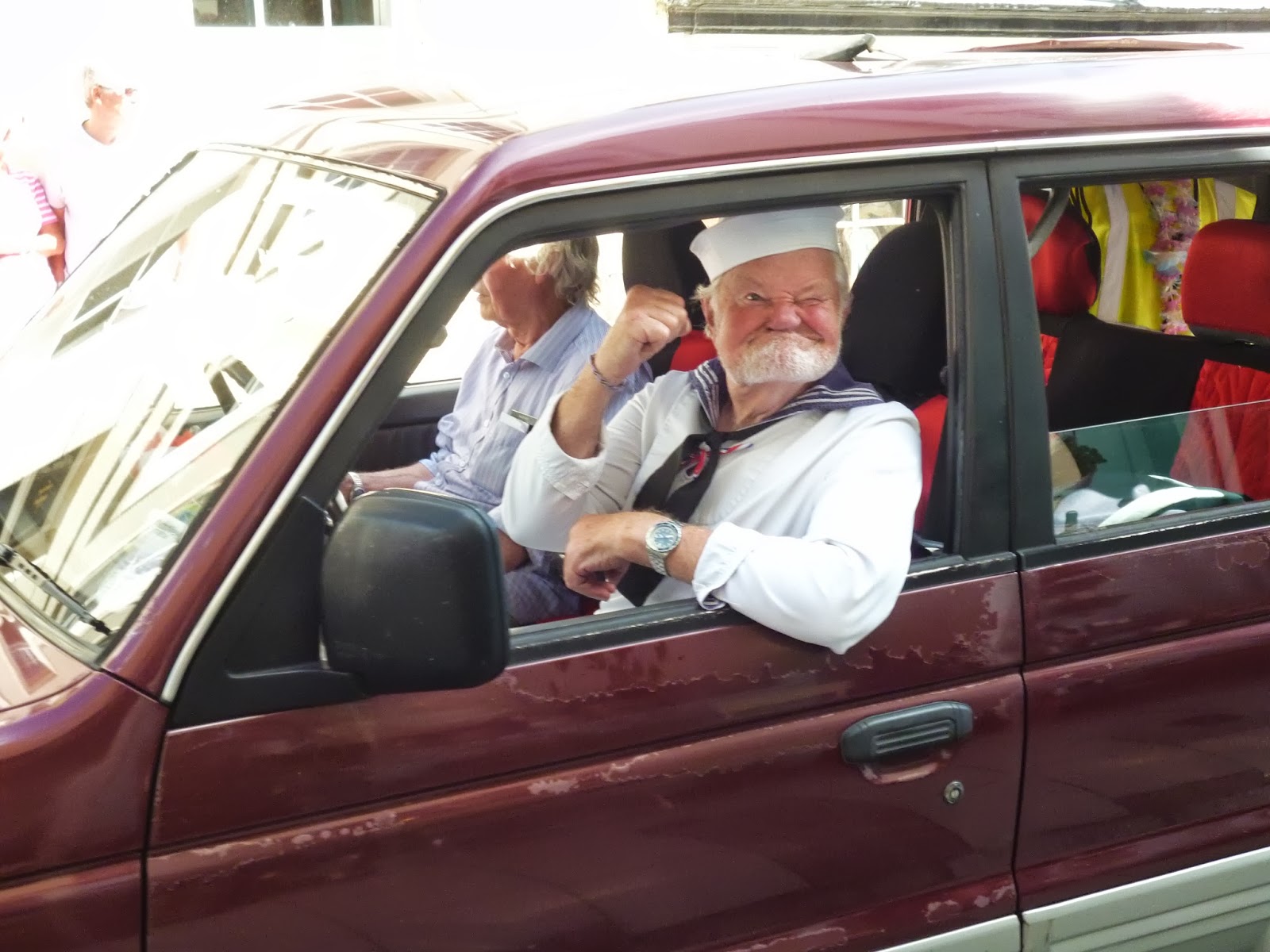
Then back to the centre of the Old Town, where we came across the carnival procession - actually the first of several processions through the week.  The purpose of this appeared to be to parade the newly-crowned Carnival Queen with her two attendants.  More dressing-up here, including the character depicted on the left, who has a tendency to wander round dressed as Popeye, and obviously felt he needed to be part of the day's antics.

The Carnival Queen duly drove by, with her ladies-in-waiting.  A charming smile and a wave clearly modelled on that of the Royals, though the carriage would probably not have made it to the Royal Mews.  The gals were shielded from the general hoi polloi with some green mesh - possibly to repel any drunken boarders spilling out from the neighbouring hostelries.

They were followed by a couple of drumming groups and - last but very much not least - a group of drum majorettes.  I have to confess here to a weakness for drum majorettes - the very name brings a smile to my lips - I think it's the "ette" bit, like "dinette" and "kitchenette" it has a nice retro feel.  The girls went by with the tall ones in front and the tinies at the back (they're the best, because they're a bit clueless and wave their batons around in a rather abstracted way).

And that was that.  We found our way back via Courthouse Street, where there was a raffle and a ribbon laid down the centre of the street on which you put a coin for charity, and then to All Saints Street, which is just  below our own street of Tackleway.  All Saints Street has its own contribution to make, in the form of a competition for the Best Dressed Window.  This year the theme is "Wonders of the Deep", which results in a variety of curious assemblages in the windows.  It's all part of life's rich pattern here on the south coast.

Antony Mair


Sunday, 4 August 2013

Hastings Old Town - centre of creativity

 Works by Jo Redpath 

When we told friends in France that we were moving to Hastings, there were mixed reactions.  The usual one was "Why Hastings?" asked with an air of perplexity.  That was easily dealt with - it had happened entirely by chance.  But one friend followed it up with - "but there won't be any cultural life there".  I know what she meant: there's no theatre to speak of and precious little in the way of classical music.  But I am constantly struck by the way in which we are surrounded by creative people of one sort or another.  This impression was reinforced by a visit to the studio of Jo Redpath, who recently moved to our street from Santiago de Compostela.  She acquired a house sandwiched between a converted hall belonging to Roland Jarvis, a rather distinguished artist who is also a master horologist, and a house belonging to a couple known to me only as Bob and Clare, whose artistic efforts are most in evidence in the costumes they put together for Jack-in-the-Green, the annual festival celebrated in Hastings at the beginning of May.

This little clutch of artists is at the other end of our street.  But from my study windows I look onto the back of a house belonging to Ken Edwards, poet, publisher and bass guitarist with local group The Moors.  And just round the corner is the home of Polo Piatti, composer and founder of the International Composers' Festival. 

Across the valley, against West Hill, we look out on the home of artist Gus Cummins RA.  At the Peasmarsh Festival recently we met another eminent artist, Laetitia Yhap,  

The town is awash with media folk, whether photographers such as Grace Lau or stylists such as Alastair Hendy.  In short, creative energy abounds.  These are all people I've become aware of over the past twelve months.  I have little doubt that there are many more we still have to come across.  Nice though it would be to have theatre and classical music on our doorstep, there's something very satisfying about being in close proximity to creators in the arts, not just performers and consumers.

Antony Mair    


Tuesday, 30 July 2013

Pope Francis - being cuddly isn't enough

Pope Francis with admirers in Brazil

Journalists have been trumpeting what appears to be a "more conciliatory tone" in Pope Francis' pronouncements on gays.  But it's all style, rather than substance.  Being homosexual by orientation has never been seen by the Church as sinful - it's homosexual activity that was always condemned, and remains so.  Forget gay marriage: you still have to be celibate if you're gay and want to stay in the Catholic Church.  

No change, either, on women priests - "that door is closed", the media-friendly prelate said to journalists, adding statements about the importance of women in the Church.  Humbug, Your Holiness.  It's like saying that women need to be appreciated for their cooking, but aren't allowed in the boardroom.

Moving into a flat, using a small car instead of a limo, carrying your own bags: these are gimmicks that will endear the pontiff to the faithful.  But double standards within the Church seem set to continue.  On Saturday the Guardian wrote about a fresh scandal brewing in the Catholic Church in Scotland, where a priest who has complained of being abused by an older priest has been ostracised and sidelined.  The message is clear: toe the line or you're out of favour.  

The Pope himself looks as if he may be heading for trouble with his appointment of Monsignor Ricca to an important position overseeing the Vatican Bank.  The appointee was formerly stationed at the Vatican Embassy in Montevideo, where, it is alleged by Italian investigative journalists, he led an openly gay life, even being caught on one occasion with a rentboy in a lift.  In most countries a charge of this nature would lead to suspension of the person concerned from his duties while the allegations are investigated.  Not in the Catholic Church, it seems, where there's one rule for the prelates and another for their flock.

Antony Mair


Monday, 29 July 2013

The Nonsense of Prince George

The earlier Prince George, 2nd Duke of Cambridge

The feeding frenzy that greeted the arrival of the newest member of the royal family last week was peculiarly repellent.  I first encountered mass hysteria - excluding of course the howls of teeny-boppers at rock concerts - with the death of Princess Diana.  In the law-firm I was working in at the time, any suggestion that Diana was other than immaculate would have had you lynched by almost every member of the female staff.  Personally, I had always found her beautiful but at the same time manipulative - and, dare I say it, in some ways she contributed to her final, if undeniably tragic, departure.

I have no such ambivalence as regards the royal infant.  But the news on the easel outside Buckingham Palace, giving brief details of the birth, was enough information.  If the media had been given the chance, paparazzi would have been pointing their lenses at the Duchess's private parts during the whole process.  It was almost impossible to avoid detailed commentary - pages of newsprint and what seemed an eternity of broadcasting time.  Then, to add to it all, articles appeared in the Sunday broadsheets about how excessive the earlier coverage had been.  No better example could be found of the media feeding on themselves.

There does seem to be an increasing tide of trivia around.  Social media have not helped.  The Facebook postings of posturing wannabes have opened far too many windows on dreary lives, and the endless tweets of self-appointed role models don't help.  I've been following two eminent poets on Twitter, whose endless tweets have, I'm afraid, entirely degraded them as far as I'm concerned.  I'd like the odd uplifting comment, please, not a stream of self-conscious gibber.

I suppose that my concern, finally, is the collapse of underlying moral values that give context and dimension to social behaviour.  If you have no defined moral framework then any behaviour becomes permissible.  Put that together with a decline in education and a rise in yob culture and what do you get?  the relentless advance of the gutter press, with all its prurient fascination in the details of private life.  

God help Prince George and his parents!

Antony Mair