 |
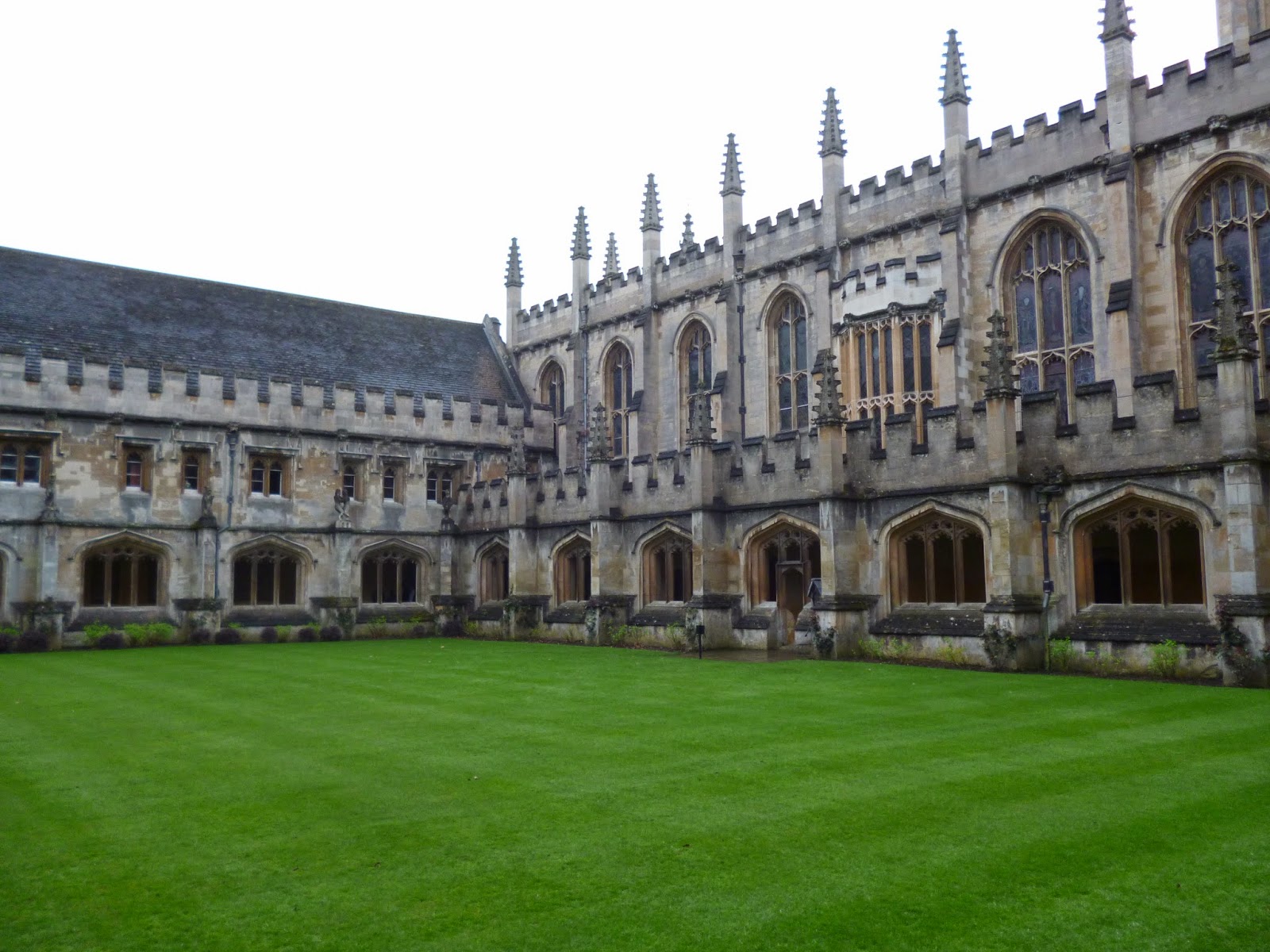
| The cloisters, Hall and chapel, Magdalen College, Oxford
To Oxford, last weekend, for a Gaudy at Magdalen. It's difficult to believe that it's fifty years since I started my degree there. I'd only been to one Gaudy before, after which I concluded that I'd been right to keep up with the people I had and not more. That was the best part of twenty years ago, when I was still in the City. It seemed churlish not to go along with the suggestions of old friends and try again.
I'd been given a room that was a sort of semi-underground burrow, with the luxury of an en suite shower room but a carpet so filthy I wasn't inclined to walk on it in bare feet. The profusion of cream paint brought back vividly the terrible drabness of so much college life. Conversation at dinner was uphill work. The speeches, by the President of the College and a knight of the realm respectively, were only semi-audible, and after straining to catch words of wisdom I concluded it wasn't worth the effort. "The trouble with men is that as they get old they either die or grow pompous," said a woman I once met. I'm not sure about the pomposity. It may be that dull is a more appropriate word.
An alarming reminder of what I was like as an undergraduate occurred when two men a little younger than me introduced themselves and asked me if I recalled their frequent visits to my rooms for coffee in my third year. Scarily, I had no recollection of either of them. One said "You were so wonderfully opinionated". So some things don't change.
I had no thrilling encounter with anyone I hadn't seen for years and who will be my new best friend. The most interesting part of the weekend was the light it shed on the tricks of memory. I had forgotten the misery of much of my time there, when I felt inadequate and depressed by the medieval melancholy of the environment. I had not realised how much of that time I had blotted out when looking back. The whole experience was amazingly valuable, and a great privilege. But I'm glad to have moved on.
One of the best things about the weekend was the poster at Oxford Station that I saw while waiting for my return train. "God shows his love for us in that while we were still sinners Christ died for us" it proclaimed. Then "To know more phone Jeff", with a telephone number and a picture of Jeff at the side. I am keen to know more about Jeff. Is he a person or a trade name - an acronym, even, for something like "Jesus Evangelises For Free"? I have a phone call to Jeff on my To Do list. Surely he tweets for Jesus?
Antony Mair
 |
Monday, 7 April 2014
College reunions - a good thing?

Sunday, 23 March 2014
Vocal Explosion in St. Clement's Church

Juliet Russell, of Vocal Explosion - courtesy of their website
We found ourselves last night in St. Clement's Church, in Hastings Old Town, to hear a programme of gypsy music from the community choir Vocal Explosion. We hadn't ventured inside this fourteenth-century gem before, but had read about its refurbishment (which aroused the usual mix of "they've ruined a lovely church" and "what an improvement on what was there before"). Personally, I quite like a mix of ancient and modern, so was not offended by the renovations. It makes a good concert venue, and the assembled ladies and gents of the community choir filed in happily to the chancel, for a programme of gypsy music from Spain to Romania.
 Community choirs make no pretension to be grand opera, the purpose being to have a good time with the music as much as to produce a decent sound. The men were, as usual, vastly outnumbered by the women - to the point where, from our position half behind a pillar, the former were completely invisible. But the women - dressed for the occasion in "sunset" colours of orange and red, some with roses in their hair - certainly seemed to be enjoying themselves, swaying and smiling in a Carmen-meets-the-WI fashion. The choir was led by Juliet Russell, who had two roses in her hair - a little offputting since from the rear they looked like a couple of stick-up ears, and reminded me slightly of Bambi, for some reason. Our neighbour in the audience, who told us she had sung with the choir for nine years but was taking a break from it at present, said that Juliet Russell composed some of the numbers herself. If so, she'd done a good job. Some of the harmonies were powerful - particularly in an opening number called Asla, which sent shivers down my spine.
The slight tendency towards a revivalist meeting became more pronounced after the break, when Juliet Russell encouraged the audience to clap rhythmically and access their inner power (I may have got that last bit wrong, but you probably get the drift). In the last number, where the choir was swaying and the audience standing and clapping I warned Paul that I might soon be speaking in tongues. The man in the row behind us said he wished the Sunday service was as lively.
I have my reservations about gypsy music - it can sound a bit same-ish after a while, and I can only take so much of dancing beside bonfires. But the rhythms were good, Juliet Russell impressed as a husky-voiced Carmen and the lady beside us was whooping with applause like any teenager. I expect to see her with a rose in her hair next time round.
Antony Mair

Sunday, 9 March 2014
And the winner is...

Taek Gi Lee playing Rachmaninov's 3rd Piano Concerto Photograph: John Cole
At the end of the semi-finals of the Hastings International Piano Concerto Competition the generally accepted view seemed to be that one of the two South Koreans - Yekwon Sunwoo and Taek Gi Lee - was likely to be winning the prize. It came as no surprise that they were two of the three finalists. Marcin Koziak, from Poland, was the third finalist, but was thought to have only an outside chance of coming out top. Of the two South Koreans, it's fair to say that Yekwon Sunwoo, with his considerable stage presence and the greater maturity that comes with being 25 as opposed to 17, was thought to be marginally the more likely contender.
The final was made the more interesting since both Yekwon Sunwoo and Taek Gi Lee were playing Rachmaninov's 3rd Piano Concerto. I invariably think of this as the "Rack 3", after John Gielgud's repeated warnings in the movie Shine that this concerto had been the downfall of many a pianist - as it proved to be for David Helfgott, the main character.
 |
| Audience at the White Rock Theatre Photograph: John Cole |
Yekwon Sunwoo was first off the starting block on Saturday night. Starting slightly nervously, he failed to convey much expression in the first part of the first movement, but gradually got into his stride. The Rack 3 is an immensely showy piece with a series of solos and cadenzas. Yekwon Sunwoo's performance reminded me very much of a mountaineer in the Alps, climbing one height after the other, only to find another one beyond. It was technically brilliant, and the final movement was a showstopper that brought tears to the eyes. He was followed by Marcin Koziak playing Tchaikovsky's 1st Piano Concerto, which I found competent but a little unmoving after the tumult of Rachmaninov.
When Taek Gi Lee stepped onto the stage I had little fear of him collapsing in the manner of David Helfgott. But I was totally unprepared for the ease with which he played - where Yekwon Sunwoo had been a mountaineer, Taek Gi Lee seemed to be taking a walk in the park. From the moment he first touched the keyboard, there was an astonishing fluidity and lyricism in his playing that captivated everyone in the theatre, bringing a number of members of the audience to their feet.
I wondered whether my judgment was affected by bias - Paul had been ferrying Taek Gi to his rehearsal venue earlier in the week as well as on the Saturday and had got to know him a little. But it became clear that everyone - including the judges - was of the same mind. He goes away with the first prize and my hope that his prodigious talent is carefully nurtured to enable him to retain a place he has now earned on the world stage.
Antony Mair
 |
| Taek Gi Lee receiving his prize from Dame Fanny Waterman Photograph: John Cole |
Friday, 7 March 2014
A feast of music at the Piano Concerto Competition Semi-final

Yekwon Sunwoo (South Korea) Photograph: John Cole
The semi-finals of the Hastings International Piano Concerto Competition brought a feast of music for those of us in the White Rock Theatre last night. For the laughable cost of £8 per seat we were treated to seven mini-recitals by a quite remarkable array of young players ranging in age from 17 to 27. There were originally intended to be six in the semi-final, but the judges considered the standard so high that they stretched it to seven. Each played a small programme of their own devising, for just under half an hour.
 |
| Marcin Koziak (Poland) Photograph: John Cole |
One of the more interesting moments occurred when Yekwon Sunwoo, also from South Korea, played Ravel's Valse. It wasn't a piece I knew, but it had been played a little earlier by another competitor, Angie Zhang from the USA. For an eighteen-year-old, she had demonstrated astonishing power - but I found myself wondering, in the course of her performance, what had happened to the dance in the title. I thought that perhaps Ravel had composed a modernist interpretation of the waltz, which broke in at odd moments. Then came Yekwon Sunwoo, who played the piece more subtly, so that the waltz rhythm was clear all the way through, with remarkable light and shade - suddenly the music was perfectly Parisian.
 |
| Taek Gi Lee (South Korea) Photograph: John Cole |
I confess to one disappointment. I'd shepherded Annika Treutler, from Germany, to rehearsal in St. Mary in the Castle and then to the White Rock in the first round. I was delighted to see that she'd made the semi-final. She played a Schumann Fantasy very beautifully last night but was trounced by the men. The standard is, indeed, amazing.
Antony Mair
 |
| The judges Photograph: John Cole |
Monday, 3 March 2014
Promoting the Piano

Ethan Richardson playing in Priory Meadow Photograph by John Cole
The Hastings International Piano Concerto Competition is now upon us. As a warm-up and a way of involving the local community, a Yamaha baby grand was placed in Priory Meadow shopping mall over last weekend and a series of players of all ages showed their skill on the keys.
Paul and I were on duty as stewards on the Sunday afternoon. A shopping mall is pretty soulless at the best of times, and Priory Meadow more so than most. Vicious draughts have a way of whistling round corners and hitting your back, and a lot of the shoppers look as if they are there as a last resort. But it was wonderful to see the power of music captured on the faces of passers-by, some of whom sat, quietly attentive, on the handful of chairs provided for the purpose. People of all ages and classes were spellbound, and I've never been so struck by the way in which music winds itself into the psyche.
Today the Competition started in earnest, with forty competitors from all over the world performing in front of a panel of judges in the White Rock Theatre. I accompanied one candidate and her accompanist (who plays the part of the orchestra, scored for piano) to St Mary in the Castle for some thunderous rehearsal of Prokoviev, then back to the White Rock Theatre where she acquitted herself admirably in front of the judges. Semi-finalists are announced on Wednesday. The six semi-finalists perform a series of recitals on the Thursday evening and are then narrowed down to three finalists, who play with full orchestra on Saturday. I'm looking forward to every minute.
Antony Mair

Isobel Richardson playing in Priory Meadow
Photograph by John Cole
Sunday, 23 February 2014
Bexhill delights
 |
| Gallery outside the Café of the De La Warr Pavilion, Bexhill
Bexhill boasts, I understand, the highest proportion of centenarians in the UK. Unsurprisingly, this makes it one of the less exciting towns along the south coast. However, it also boasts the De La Warr Pavilion, an Art Deco gem that has a popular art gallery as well as an auditorium regularly filled not only for the visiting Z-list pop-stars that blight seaside towns but also movies and live transmissions from opera houses and the National Theatre.
Since it's a short, if painfully slow, drive from Hastings, we go over from time to time. The other day we went to see the two exhibitions that are on, of works by Alison Turnbull and Matt Calderwood.
The Pavilion's website says that Alison Turnbull is known for the intricate abstract paintings and drawings she creates from found materials, such as diagrams, plans, charts and maps. The exhibition presents new and recent works exploring ideas around observation, orientation and perspective.  In the course of my current MA my tutor, Eoghan Walls, has been emphasising the importance in contemporary poetry of the concrete and specific. As a result, there's a curious culture shock for me, now, in encountering conceptual works of visual art that are said to be "exploring ideas". I've always been interested in contemporary art, though I find much of it baffling. A curator friend of mine encouraged me, many years ago, not to be too analytical, but to "follow the clues". I found this less helpful than picking up on what I came to think of as resonance - there were times when I hadn't the vaguest idea of what the artist was doing, but found myself thinking of it several days later. In the course of my current MA my tutor, Eoghan Walls, has been emphasising the importance in contemporary poetry of the concrete and specific. As a result, there's a curious culture shock for me, now, in encountering conceptual works of visual art that are said to be "exploring ideas". I've always been interested in contemporary art, though I find much of it baffling. A curator friend of mine encouraged me, many years ago, not to be too analytical, but to "follow the clues". I found this less helpful than picking up on what I came to think of as resonance - there were times when I hadn't the vaguest idea of what the artist was doing, but found myself thinking of it several days later.
But I'm afraid it wasn't working with Alison Turnbull's carefully planned and detailed paintings, meticulously executed though they were. Sometimes, I'm afraid, it's just a question of taste.
 On an upper level of the Pavilion, Matt Calderwood had assembled a group of structures that had stood outside in the open for a number of months and bore the effects of weather. The Pavilion website says: Exposure Sculpture (2013) are geometric structures made from welded steel clothed in billboard paper. Located on the roof during the summer months, they have now been reassembled in the gallery space and reveal the results from the four months' exposure to the elements during the outdoor installation prior to the exhibition. Sorry, Mr Calderwood, I don't get this either. On an upper level of the Pavilion, Matt Calderwood had assembled a group of structures that had stood outside in the open for a number of months and bore the effects of weather. The Pavilion website says: Exposure Sculpture (2013) are geometric structures made from welded steel clothed in billboard paper. Located on the roof during the summer months, they have now been reassembled in the gallery space and reveal the results from the four months' exposure to the elements during the outdoor installation prior to the exhibition. Sorry, Mr Calderwood, I don't get this either.
Don't get me wrong. I'm delighted to have been to these exhibitions and would like to understand a bit better what these artists are getting at. In both cases the artists have given talks in the Pavilion, explaining their intentions, It's a pity there's no recording of these presentations on the website. It doesn't mean that understanding their intention better would necessarily make me like what they're dong. But at least I'd be better informed.
As it is, I'm afraid we had to take refuge in the Trattoria Italiana, a bustling restaurant on the seafront, before ambling along the front in the sun. There are worse ways of spending the day.
|
Antony Mair

Tuesday, 18 February 2014
Gearing up for the Piano Concerto Competition

The first three weeks of March in Hastings are devoted to the Hastings Musical Festival, which has been going for more than a century. It's not a festival like those in Edinburgh or Brighton, but consists of a series of competitions for performers in music and dance. In recent years the jewel in the crown of the Festival has been the Hastings International Piano Concerto Competition, which takes place in the first week of March, the final being on Saturday March 8th.
Last year we were in the audience for the final, which was an amazing event. This year we have foolishly volunteered to help with the running of the Competition, together with about twenty others. Not, you will understand, in any highfalutin fashion: our tasks will be restricted to guiding contestants from rehearsal venues to the stage of the White Rock Theatre for their performance. On the night of the final we are likely to be selling programmes.
So today saw the small volunteer army being inducted to the mysteries of the White Rock Theatre, better known for performances by popstar lookalikes and the occasional dire production of classical opera and ballet. There's the usual labyrinth of backstage corridors and small dressing-rooms, and that strange feeling, when you come on stage, of the auditorium being somehow smaller than you thought it would be. We were given a slightly bewildering list of instructions by our masters, and I left hoping that I would be able to deliver my charges safely to the venue for their allotted time without accident or mishap. No doubt all will come right on the night. At least on the final evening we shall be doing some fairly brainless activity rather than shepherding our virtuosos to the Yamaha grand. I'm just hoping we'll be able to hear the performances as well.
Antony Mair
Subscribe to:
Posts (Atom)